01 · The stories
Myths & defining acts
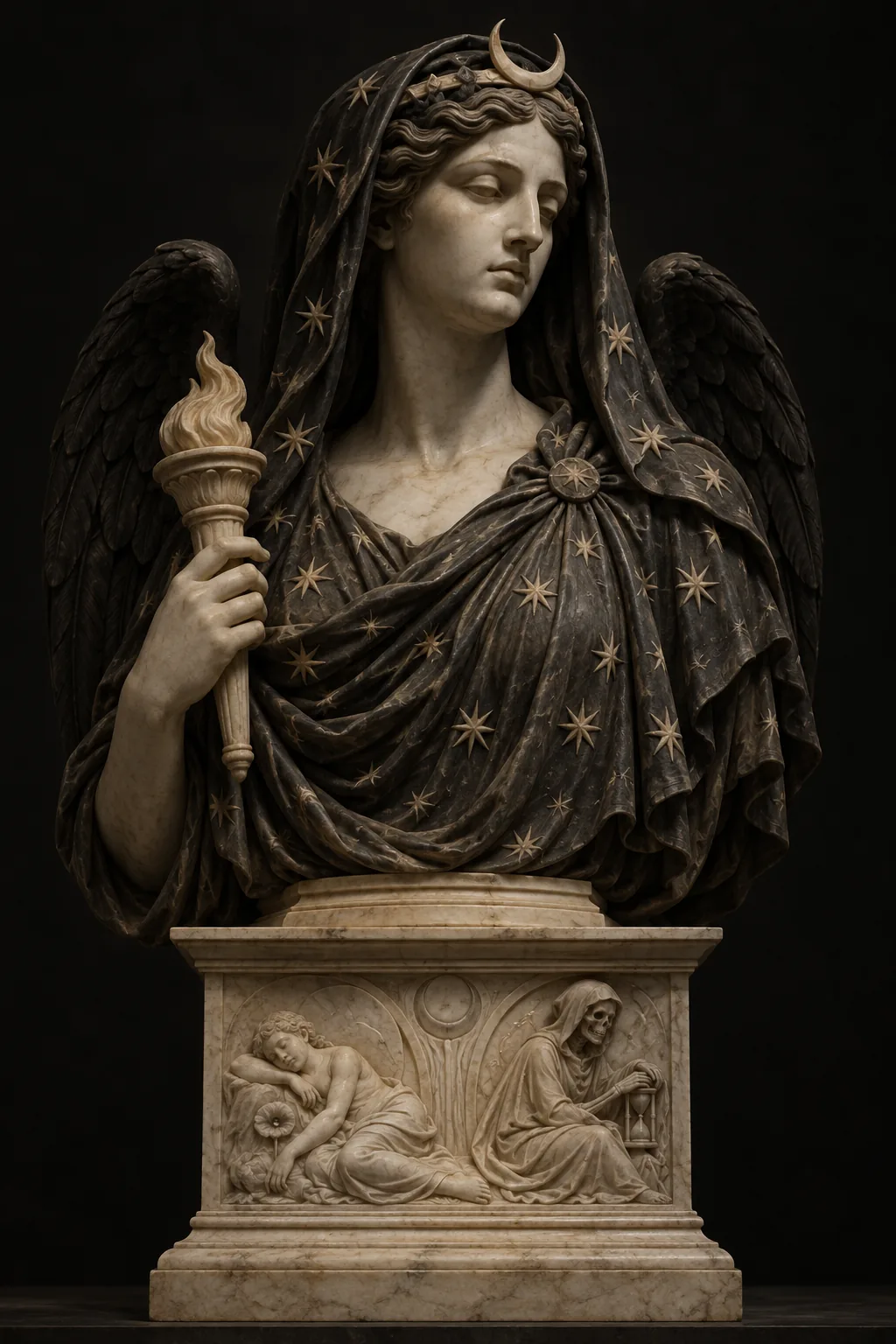
Shelters Sleep from Zeus (Iliad 14.256–261); bears Death, Sleep and other dark powers (Hesiod, Theogony 211–232).
02 · Sacred lineage
Family & relations
In Hesiod, Night is born after Chaos and Earth (Theogony 116–125) and bears Doom, Fate, Death, Sleep, the tribe of Dreams, Blame, Woe, the Hesperides, Strife and others, in several cases without a father (211–232).
Greek literary genealogies and Roman cult identities are not interchangeable. Explore the family tree and its traditions.
03 · Places of devotion
Abode & sacred sites
In Hesiod, the awful home of murky Night stands in the underworld, wrapped in dark clouds, where Night and Day draw near and greet one another as they pass over the great threshold (Theogony 744–748).
04 · Two traditions
Greek & Roman perspectives
The Greek perspective
In the Iliad, Hypnos says he took refuge with Night when Zeus was angry with him, and Zeus held back out of respect for her (14.256–261).
The Roman perspective
Night appears in Roman poetry as Nox; the sources cited here do not describe a cult.
05 · Extensive analysis
A closer reading
Hesiod places Night among the first beings and gives her a long list of dark children. Homer's Iliad shows Zeus holding back from displeasing her.
06 · Primary sources
What the sources say
These are the main ancient passages behind this entry, with what each one actually says.
- Hesiod, Theogony lines 211–232
Night bears Doom, Fate, Death, Sleep and the tribe of Dreams, and, though she lay with none, Blame, Woe, the Hesperides and, in the same list, Strife.
Read the passage - Hesiod, Theogony lines 744–748
There stands the awful home of murky Night wrapped in dark clouds, where Night and Day draw near and greet one another.
Read the passage - Homer, Iliad book 14, lines 256–261
Sleep recalls taking refuge with Night, whom Zeus respects.
Read the passage
07 · Story & deeper insight
Nyx: the night even Zeus respects
Hypnos recalls how Zeus once pursued him in anger after he had put the god to sleep. He escaped by taking refuge with Nyx, and Zeus held back out of respect for her. The brief recollection gives Night exceptional standing without requiring a battle or a long heroic narrative.
In Hesiod's genealogy, Nyx generates powers connected with mortality, distress and the limits of human life, alongside figures such as Sleep. Night becomes a way to describe experiences that cannot be mastered by daylight's ordinary activity. Her family is a poetic organisation of forces, rather than a complete psychological theory.
Her comparatively limited narrative presence does not make her insignificant: the episode in Homer places a constraint on the most powerful Olympian. Nyx offers a reminder that divine sovereignty exists within a wider cosmos. Some primordial powers remain older than, and not wholly absorbed by, the order Zeus governs.