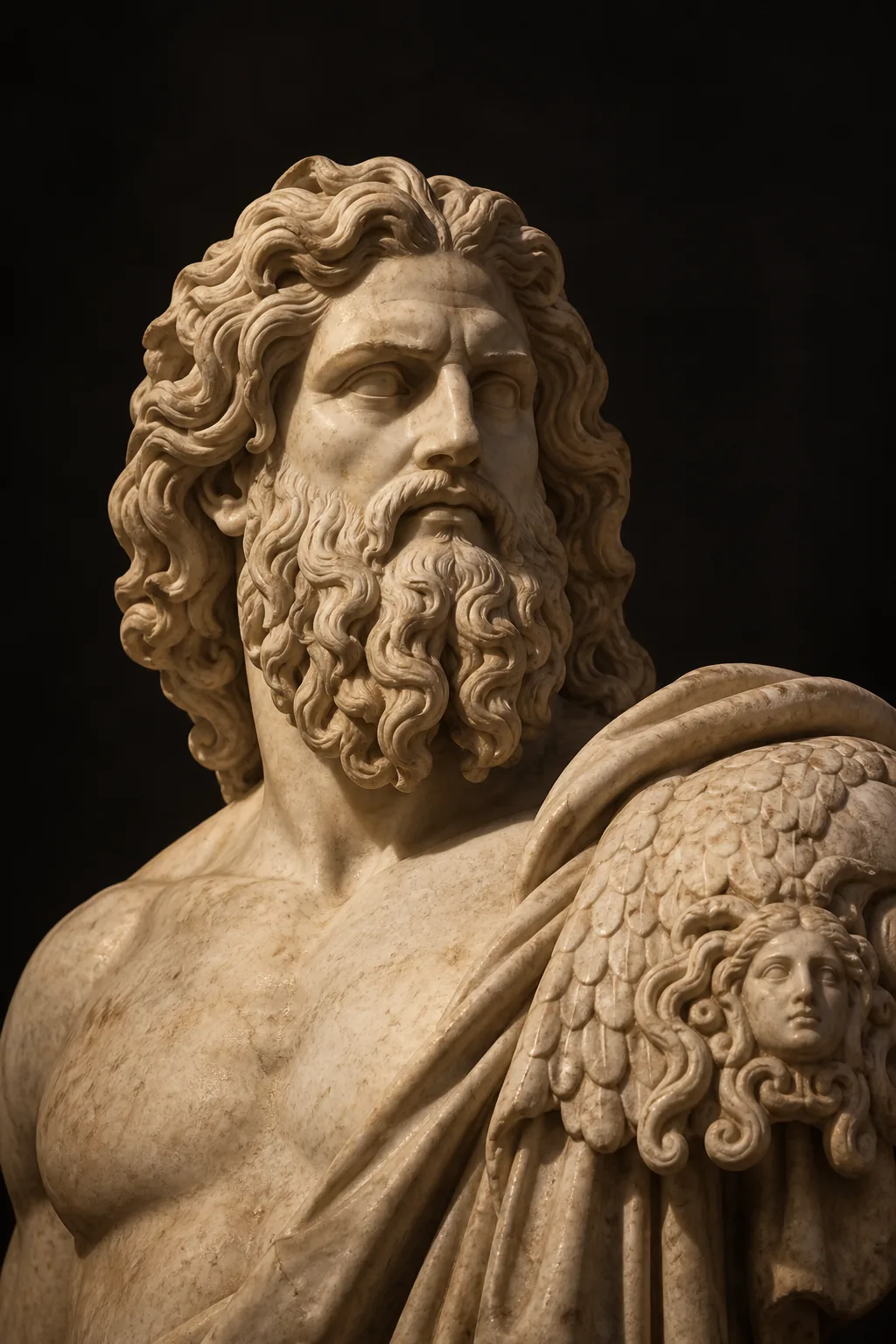
01 · The stories
Myths & defining acts
Hidden as an infant on Crete and saved from Cronus (Theogony 453–491); overthrows the Titans (Theogony 617–735); with Poseidon and Hades divides the world by lot (Iliad 15.187–193); swallows Metis and bears Athena (Theogony 886–900, 924–926); loves Europa, Leda and Danae (Apollodorus 3.1.1, 3.10.7, 2.4.1) and takes Ganymede to be his cupbearer (Iliad 20.232–235); and, when he wants to destroy the bronze race, sends the flood in Deucalion's time (Apollodorus 1.7.2).
02 · Sacred lineage
Family & relations
Parents: Cronus and Rhea. Siblings: Poseidon, Hades, Hera, Demeter and Hestia (Hesiod, Theogony 453–458). Wife: Hera. Children named in the sources include Athena, Apollo, Artemis, Ares, Hermes, Dionysus and Heracles (Theogony 886–944); Perseus, by Danae (Apollodorus 2.4.1); and Helen, by Leda (Apollodorus 3.10.7).
Greek literary genealogies and Roman cult identities are not interchangeable. Explore the family tree and its traditions.
03 · Places of devotion
Abode & sacred sites
Mount Olympus; Dodona, where Homer's Achilles prays to 'Zeus of Dodona' (Iliad 16.233) and Odysseus goes to hear the will of Zeus from the oak (Odyssey 14.327–330); Olympia, with the gold-and-ivory statue by Pheidias described by Pausanias (5.11); Mount Lycaeus in Arcadia, where, Pausanias says, Zeus was reared (8.38.2); and, in Rome, the Capitoline temple of Jupiter Optimus Maximus (Livy 1.55).
04 · Two traditions
Greek & Roman perspectives
The Greek perspective
Hesiod makes Zeus the youngest child of Cronus and Rhea, who overthrows Cronus and the Titans and takes many wives and lovers (Theogony). The Odyssey presents him as the protector of strangers and suppliants.
The Roman perspective
In Livy, the fetial priest swears the treaty between Rome and Alba by calling on Jupiter to hear the terms (1.24). Modern reference works record that consuls swore their oath of office in Jupiter's name and that triumphing generals wore regalia associated with him.
05 · Extensive analysis
A closer reading
Zeus and Jupiter are matched in Greek and Roman sources, and modern scholars derive both from a common Indo-European sky god, *Dyeus. Greek writers tell stories of Zeus's family, his battles and his loves. In Roman writing, Jupiter appears chiefly in public ritual: the Capitoline temple, oaths, treaties and the consuls' vows.
06 · Primary sources
What the sources say
Zeus is attested from the earliest Greek literature. These are the main ancient passages behind this entry, with what each one actually says.
- Hesiod, Theogony lines 453–491
Rhea bears Zeus as the youngest of Cronus's children. Cronus swallows each child at birth because he has learned he will be overcome by his own son. Earth and Heaven send Rhea to Lyctus in Crete; Earth hides the infant in a cave on Mount Aegeum and gives Cronus a great stone wrapped in swaddling clothes, which he swallows in the child's place.
Read the passage - Hesiod, Theogony lines 886–929
Zeus's unions in order: Metis (swallowed by him, after which Athena is born), Themis (the Horae and the Moirai), Eurynome (the Graces), Demeter (Persephone), Mnemosyne (the Muses), Leto (Apollo and Artemis) and, last, Hera (Hebe, Ares and Eileithyia).
Read the passage - Homer, Iliad book 15, lines 187–193
Poseidon reminds Zeus that Rhea bore three brothers to Cronus: Zeus, Poseidon and Hades. The world was divided into three parts by lot; the sea fell to Poseidon, the darkness below to Hades, and the sky to Zeus.
Read the passage - Pausanias, Description of Greece book 5, chapter 11
Pausanias describes the seated statue of Zeus at Olympia (made by Pheidias) in gold and ivory, with a Victory in its right hand and a sceptre topped by an eagle in its left. He writes that no measurement of its size could convey the impression of seeing it.
Read the passage - Virgil, Aeneid book 1, lines 278–279
In the Roman epic, Jupiter promises Venus that he sets no limits of space or time on the Romans' power. This is the Roman poetic version of the god as guarantor of Rome's destiny.
Read the passage - Homer, Odyssey book 9, lines 270–271
Odysseus warns the Cyclops that Zeus avenges suppliants and strangers.
Read the passage - Homer, Iliad book 16, line 233
Achilles prays to Zeus, lord of Dodona.
Read the passage - Homer, Odyssey book 14, lines 327–330
Odysseus is said to have gone to Dodona to hear the will of Zeus from the high-crested oak of the god.
Read the passage - Homer, Iliad book 8, line 247
Zeus sends an eagle with a fawn in its talons as an omen.
Read the passage - Homer, Iliad book 20, lines 232–235
The gods carried off Ganymede, the most beautiful of mortals, to be Zeus's cupbearer.
Read the passage - Pausanias, Description of Greece book 8, chapter 38, section 2
On Mount Lycaeus, the Arcadians say, Zeus was reared.
Read the passage - Apollodorus, Library book 2, chapter 4, section 1
Zeus has intercourse with Danae, who bears Perseus.
Read the passage - Apollodorus, Library book 3, chapters 1 and 10
Zeus, in the form of a swan, consorts with Leda, and she bears Pollux and Helen to him; in the form of a bull he carries off Europa.
Read the passage - Apollodorus, Library book 1, chapter 7, section 2
When Zeus wants to destroy the bronze race, Deucalion and Pyrrha survive the flood.
Read the passage - Livy, Ab Urbe Condita book 1, chapter 24
In the treaty between Rome and Alba, the fetial priest calls on Jupiter to hear the terms.
Read the passage - Wikipedia, Jupiter (mythology), a modern summary section on the Capitoline cult
Consuls swore their oath of office in Jupiter's name and honoured him on the annual feriae of the Capitol; triumphing generals bore regalia associated with Rome's kings.
Read the passage - Wikipedia, Dyeus, a modern summary introduction
The Proto-Indo-European sky god *Dyēus is the reconstructed source of Greek Zeus and Roman Jupiter.
Read the passage
Where the sources differ
- Hesiod places Hera last among Zeus's wives and has her bear Hebe, Ares and Eileithyia (Theogony 921–923). In the same passage he says Hera bore Hephaestus on her own, without Zeus (Theogony 927–929), so Hephaestus's father is not the same in every source.
- Homer makes Aphrodite the daughter of Zeus, with Dione as her mother (Iliad 5.131, 5.348 and 5.370). Hesiod has her rise from the foam around the severed genitals of Uranus (Theogony 188–206), so in Hesiod she is not Zeus's child at all.
07 · Story & deeper insight
Zeus and the overthrow of the Titans
Cronus swallowed his children to prevent a foretold overthrow. Rhea saved the youngest, Zeus, by handing Cronus a wrapped stone and hiding the infant. Once grown, Zeus brought his siblings back into the world and challenged the Titans. Victory depended on alliances: the Cyclopes supplied the thunderbolt, and the Hundred-Handers helped break the older gods' resistance.
The succession story asks how legitimate authority emerges from violence. Zeus differs from Cronus because he distributes honours and incorporates allies, although his later swallowing of Metis shows that fear of replacement survives the change of ruler. Divine order is negotiated as well as enforced.
Jupiter inherited Greek narratives through Roman literature, but Roman worship gave sovereignty a different public setting. Oaths, magistracies and the Capitoline temple made him a protector of collective order. Reading Zeus's family struggle beside Jupiter's civic authority reveals how shared mythology could serve different political communities.