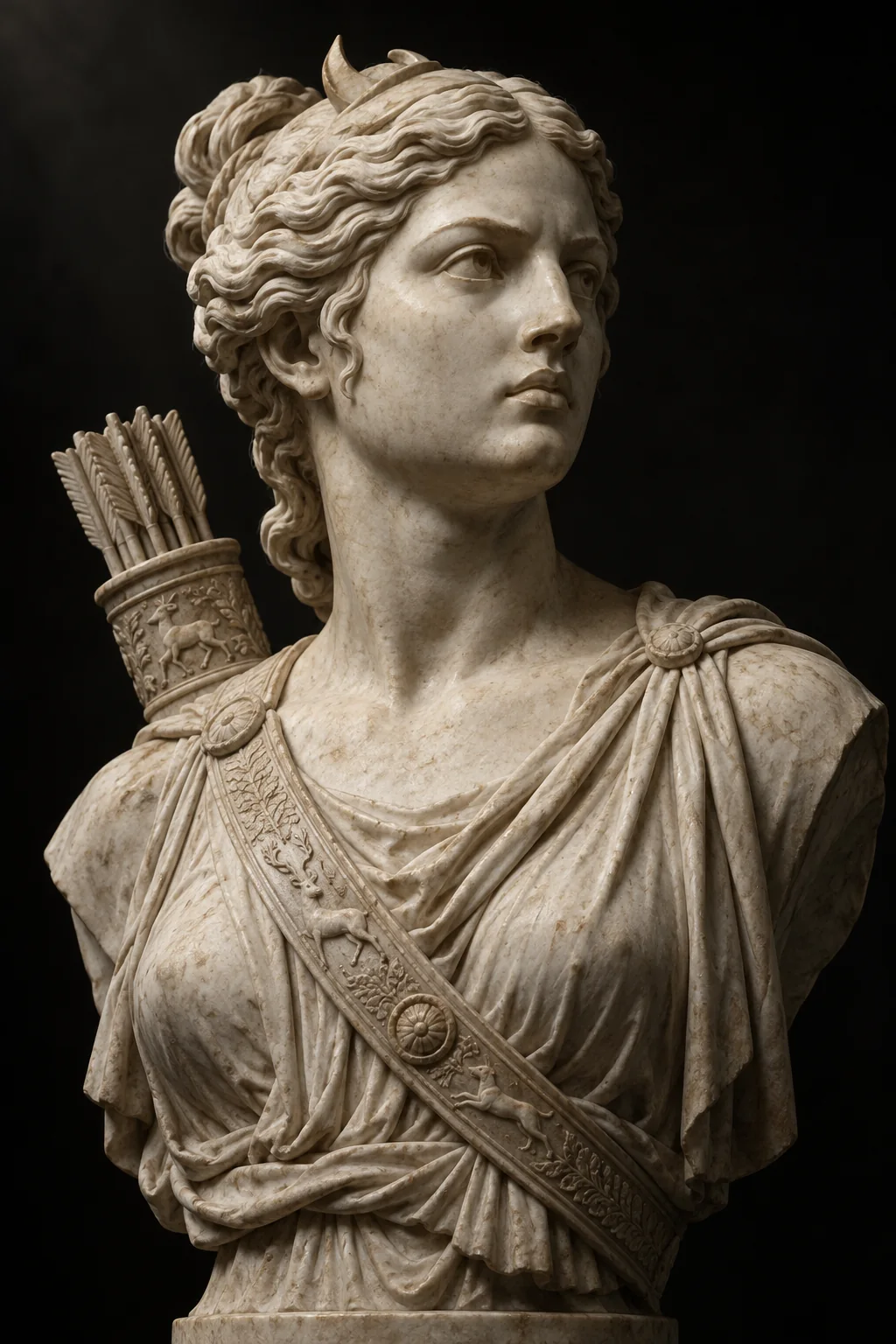
01 · The stories
Myths & defining acts
Kills Orion on Delos (Apollodorus 1.4.3); Actaeon is turned into a stag after seeing her (Ovid, Metamorphoses 3.138–252); with Apollo, kills the children of Niobe (Apollodorus 3.5.6); and, in Apollodorus, Adonis is killed by a boar through her anger (3.14.4).
02 · Sacred lineage
Family & relations
Parents: Zeus and Leto (Hesiod, Theogony 918–920). Twin brother: Apollo. In Apollodorus, Artemis devoted herself to hunting and remained a maiden (Library 1.4.1).
Greek literary genealogies and Roman cult identities are not interchangeable. Explore the family tree and its traditions.
03 · Places of devotion
Abode & sacred sites
Delos, where she was born; Brauron, Munichia, Delphi and Ephesus are among the cult places that modern reference works list for Artemis. In Italy, her grove at Aricia on Lake Nemi, where Strabo describes the rites as barbarous and Scythian (5.3.12).
04 · Two traditions
Greek & Roman perspectives
The Greek perspective
In the Iliad, Artemis rebukes her brother Apollo for refusing to fight Poseidon and asks why he keeps his bow idle (21.470–477). In Apollodorus, she kills Orion on Delos (1.4.3), and Actaeon is transformed into a stag and killed by his own hounds in Ovid's version (Metamorphoses 3.138–252).
The Roman perspective
At the grove of Diana at Nemi (Diana Nemorensis), Strabo says the priest was a fugitive who had murdered his predecessor with his own hand, and was always armed with a sword for fear of attack (5.3.12). Modern reference works list the Nemoralia as her festival there and note a temple of Diana in Rome.
05 · Extensive analysis
A closer reading
Artemis is Apollo's twin sister and the goddess of hunting. In Ovid she is Diana, whose grove at Nemi in Italy had a priesthood that Strabo describes as bloody. The Greek and Roman sources agree that she is a virgin huntress.
06 · Primary sources
What the sources say
These are the main ancient passages behind this entry, with what each one actually says.
- Hesiod, Theogony lines 918–920
Leto bears Apollo and Artemis, twin children of Zeus who delight in arrows.
Read the passage - Homer, Iliad book 21, lines 470–477
When Apollo refuses to fight Poseidon, his sister Artemis, patroness of wild beasts, angrily rebukes him for fleeing and asks why he keeps his bow idle.
Read the passage - Ovid, Metamorphoses book 3, lines 138–252
In a shaded valley sacred to Diana, the hunter Actaeon surprises her and is transformed into a stag, then killed by his own hounds.
Read the passage - Apollodorus, Library book 1, chapter 4, section 1
Leto gives birth first to Artemis and then, with her help, to Apollo; Artemis devotes herself to hunting and remains a maiden.
Read the passage - Apollodorus, Library book 1, chapter 4, section 3
Artemis slays Orion on Delos.
Read the passage - Apollodorus, Library book 3, chapter 5, section 6
Amphion marries Niobe, daughter of Tantalus, who bears seven sons and seven daughters; the children are later killed by Apollo and Artemis.
Read the passage - Strabo, Geography book 5, chapter 3, section 12
At Aricia is the Artemisium called Nemus, said to be consecrated to Diana Taurica, with barbarous rites; the priest is a fugitive who has murdered his predecessor and is always armed.
Read the passage - Wikipedia, Artemis, a modern summary section on worship
Lists Athens, Brauron and Munichia, Delos, Delphi and Ephesus among the places of her worship.
Read the passage - Wikipedia, Diana (mythology), a modern summary infobox
Lists the sanctuary at Lake Nemi and the Temple of Diana in Rome among her temples, and the Nemoralia as her festival.
Read the passage
Where the sources differ
- Homer and Hesiod use the Greek name Artemis; Ovid writes of Diana in Latin. His Actaeon story is a Roman literary treatment of the goddess, not a description of Greek cult.
07 · Story & deeper insight
Artemis, Diana and the fate of Actaeon
The hunter Actaeon wanders into a secluded place where Diana and her attendants are bathing. In Ovid's version the encounter is accidental, but the goddess transforms him into a stag. His own hounds pursue and tear him apart. He retains awareness yet cannot speak his identity, while his companions call for the absent hunter to witness the kill.
The reversal makes the boundary of divine privacy visible through a loss of human protection. A hunter becomes quarry; his familiar animals no longer recognise him. The narrative is disturbing precisely because the punishment exceeds a deliberate offence in this telling. Other ancient versions assign different causes, so the accident should not be presented as universal.
Actaeon's story captures the danger of crossing into a divine domain without permission. It also asks whether proximity to a god guarantees justice measured on a human scale.