01 · The stories
Myths & defining acts
At Hera's request, puts Zeus to sleep during the Trojan War so that Poseidon can help the Greeks; Hera promises him Pasithea, and Sleep recalls that Zeus once nearly hurled him from the sky until Night sheltered him (Iliad 14). In Virgil's Aeneid, lulls Palinurus to sleep and he falls into the sea (Aeneid 5).
02 · Sacred lineage
Family & relations
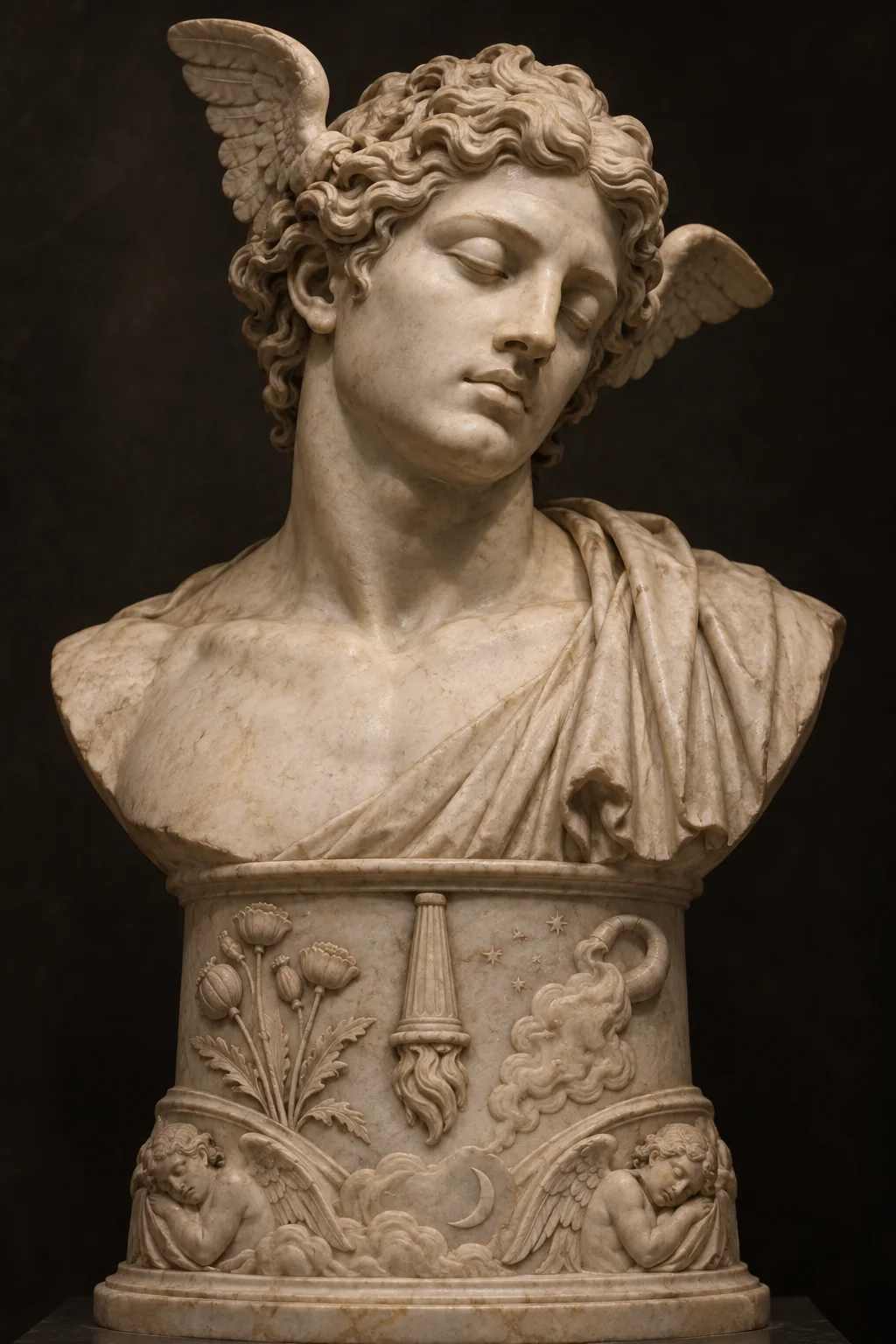
In Hesiod, Night bears Sleep without a father, together with Death and the tribe of Dreams (Theogony 211–213), and Sleep is the brother of Death (Theogony 756–759). In the Iliad, Hera promises Sleep that he may marry Pasithea, one of the younger Graces (14.267–269). Ovid names Morpheus, Icelos (called Phobetor by mortals) and Phantasos as sons of Hypnos (Metamorphoses 11.633–646).
Greek literary genealogies and Roman cult identities are not interchangeable. Explore the family tree and its traditions.
03 · Places of devotion
Abode & sacred sites
In Ovid, a cave near the land of the Cimmerians, where the sun never reaches, the river Lethe flows, and poppies and other herbs grow at the entrance (Metamorphoses 11.592–608). In the Iliad, Hera finds Sleep on the island of Lemnos (14.230–231). Pausanias saw a figure of Sleep in the sanctuary of Asclepius at Sicyon (2.10.2).
04 · Two traditions
Greek & Roman perspectives
The Greek perspective
In the Iliad, Sleep is called the own brother of Death (14.231). Hesiod places the dwellings of Sleep and Death in the underworld, and in the Theogony Night's children Sleep and Death are awful gods (756–759).
The Roman perspective
In Roman poetry, Somnus appears in Virgil's Aeneid, where he takes the shape of Phorbas to lull the helmsman Palinurus and cast him overboard (5.835–871), and in Ovid's cave of Somnus (Metamorphoses 11).
05 · Extensive analysis
A closer reading
Hesiod makes Sleep and Death brothers, both sons of Night, and the Iliad calls Sleep the brother of Death. Ovid's cave of Somnus is a place without sound, where the river Lethe murmurs and poppies grow at the door. There was some cult: Pausanias saw a figure of Sleep at Sicyon, though in the surviving literature he appears chiefly as a character in stories.
06 · Primary sources
What the sources say
These are the main ancient passages behind this entry, with what each one actually says.
- Hesiod, Theogony lines 211–213 and 756–759
Night bears Doom, Fate, Death, Sleep and the tribe of Dreams without lying with anyone; elsewhere Hesiod calls Sleep the brother of Death and says both live in the underworld.
Read the passage - Homer, Iliad book 14, lines 230–279
Hera meets Sleep on Lemnos, calls him own brother to Death, and promises him Pasithea, one of the youngest of the Graces, if he puts Zeus to sleep; Sleep recalls having once escaped the anger of Zeus.
Read the passage - Ovid, Metamorphoses book 11, lines 592–646 (Latin text)
Near the Cimmerians is a cave, the home of Sleep, where the sun never reaches, the river Lethe murmurs, and poppies grow at the door; Sleep's sons are Morpheus, Icelos (Phobetor to mortals) and Phantasos.
Read the passage - Virgil, Aeneid book 5, lines 835–871 (Latin text)
Somnus, in the form of Phorbas, lulls the helmsman Palinurus to sleep and throws him overboard.
Read the passage - Pausanias, Description of Greece book 2, chapter 10, section 2
At Sicyon, in the sanctuary of Asclepius, there is a figure of Sleep in the outer room of a two-roomed building.
Read the passage
07 · Story & deeper insight
Hypnos puts Zeus to sleep
Hera needs Zeus distracted so that the Greeks can receive assistance on the battlefield. Hypnos initially refuses to help, recalling an earlier deception when Zeus's anger nearly destroyed him. Only the protection of Nyx saved him. Hera's promise of marriage to Pasithea eventually persuades him, and he waits in concealment before bringing sleep upon the king of the gods.
The episode makes an apparently gentle power strategically decisive. Sleep suspends vigilance and creates an opening even in the highest authority. Hypnos must nevertheless judge political risk: his ability is immense, but it does not make him immune to retaliation when Zeus wakes.
Roman Somnus carries comparable imagery in poetry, often dwelling in a quiet place remote from ordinary disturbance. The Greek battle episode and the Roman landscapes of sleep emphasise different aspects of the same experience. Rest can restore life, but temporary unconsciousness also exposes every sleeper to dependence on the world around them.