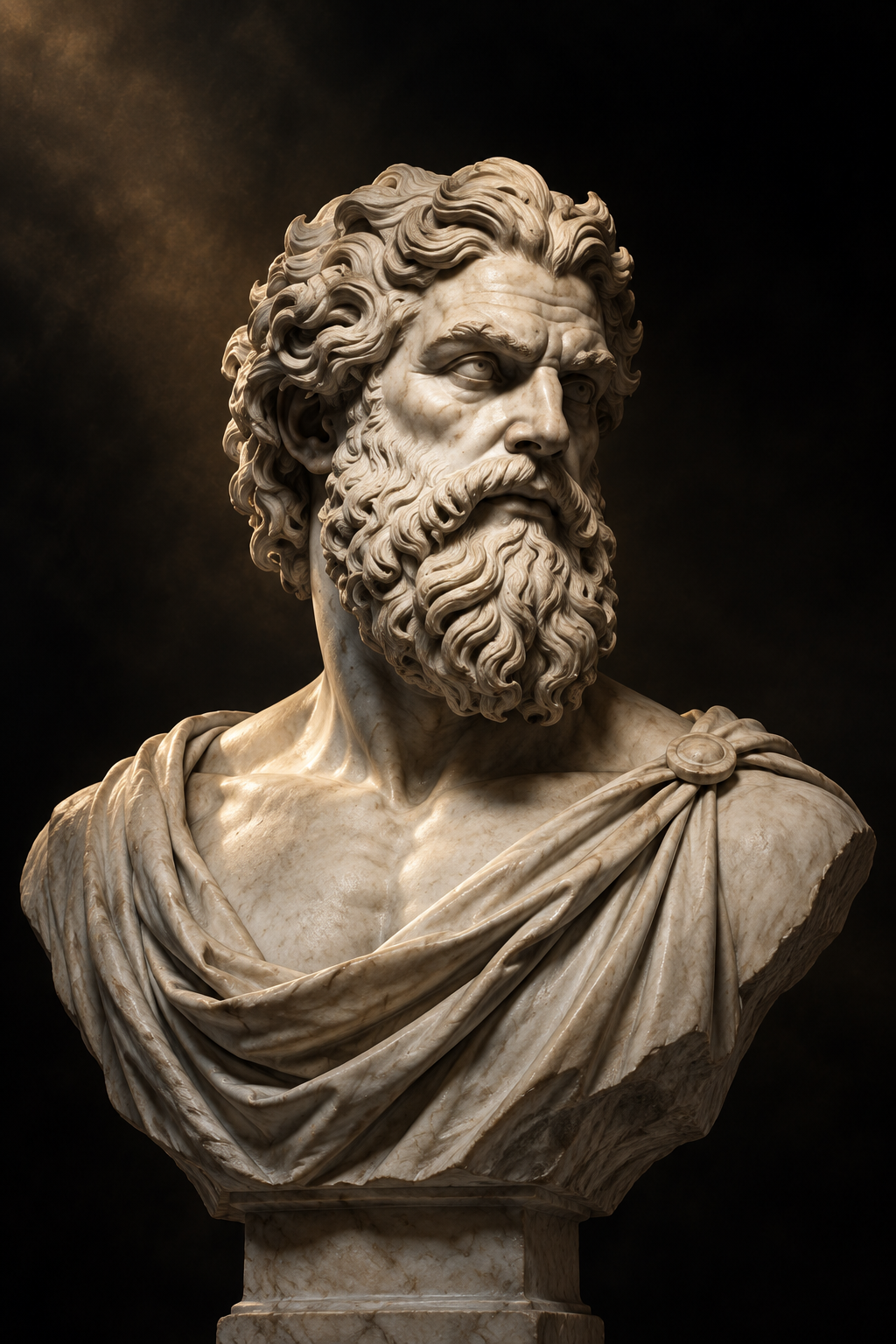
01 · The stories
Myths & defining acts
Hated his monstrous children and pushed them back into Gaia's body; in agony she made a sickle and asked her sons to act; Cronus ambushed and castrated him, throwing the parts into the sea, from which Aphrodite was born and from whose blood came the Giants, the Furies and the ash-tree nymphs; the dying Uranus prophesied that Cronus too would fall to his own son.
02 · Sacred lineage
Family & relations
Son and then consort of Terra (Gaia), the Earth. With her, father of the twelve Titans, the three Cyclopes and the hundred-handed Hecatoncheires.
03 · Places of devotion
Abode & sacred sites
The dome of the sky, lying over the Earth.
04 · Two traditions
Greek & Roman perspectives
Uranus (Ouranos)
The starting point of the standard Hesiodic creation story rather than a worshipped god; sky as a cosmic principle, with essentially no personality and no cult.
Caelus
Little independent worship. Used as Caelus in cosmological contexts and imperial art - he appears holding the celestial mantle on the breastplate of the Augustus of Prima Porta, framing the emperor's rule as cosmic.
05 · Extensive analysis
A closer reading
Uranus is the first sky-father and first king of the universe in Greek cosmogony, and his story exists almost entirely to explain how divine power passes from one violent generation to the next: he is overthrown and unmanned by his son Cronus, who is in turn overthrown by his son Zeus. He has no real cult in either culture; the Romans treated Caelus the same way, as the physical heavens given a name and, occasionally, a useful role in imperial imagery.
06 · Sources
From the archive
Text from Gods · greek_roman_gods, row 19. Imported 10 September 2026.