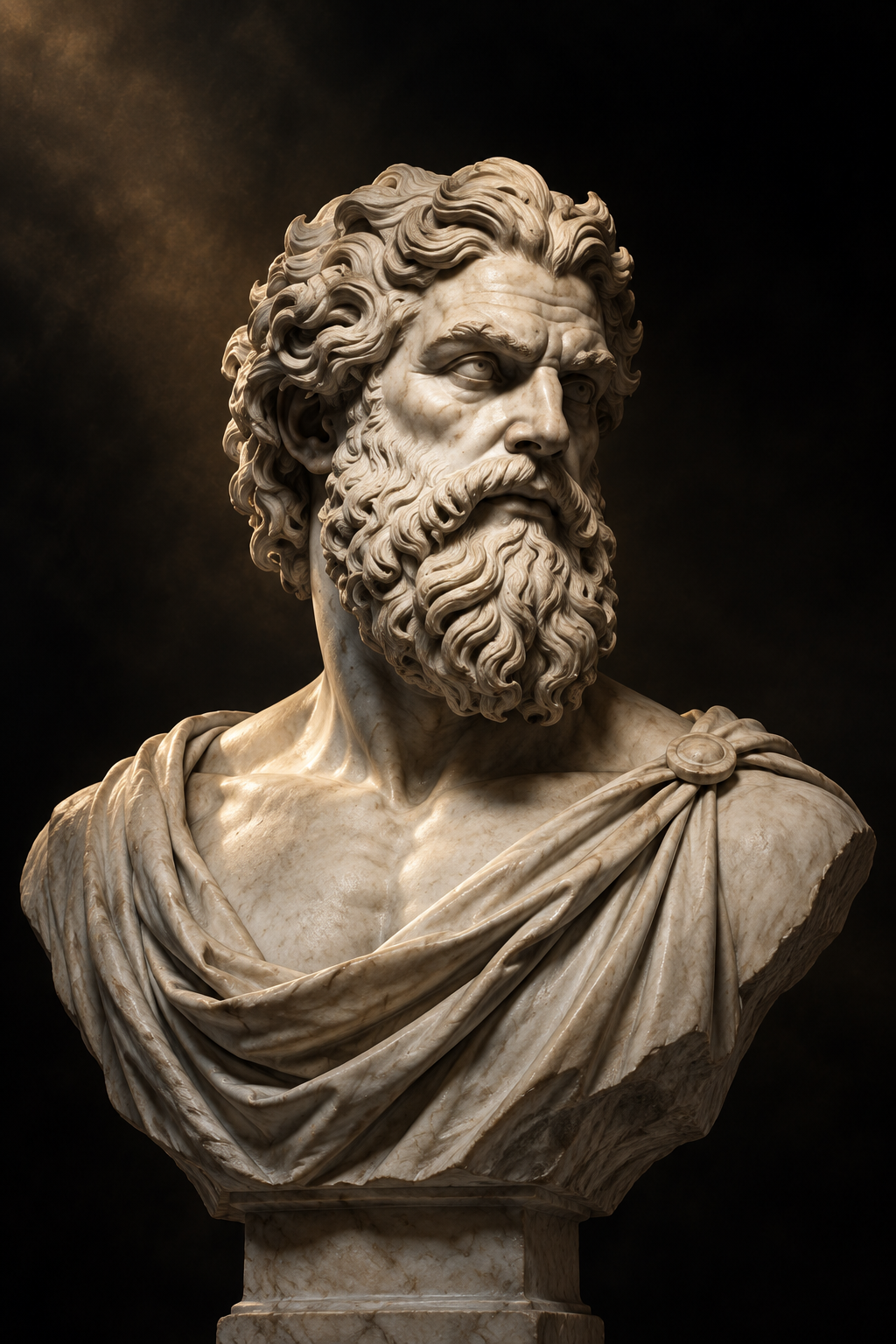
01 · The stories
Myths & defining acts
Bore six children to Cronus and watched him swallow five; fled to Crete pregnant with Zeus, gave birth in the cave on Mount Ida, and outwitted Cronus with the stone; later helped restore the disgorged Olympians and revived the dismembered Pelops.
02 · Sacred lineage
Family & relations
Parents: Caelus (Uranus) and Terra (Gaia). Husband and brother: Saturn (Cronus). Mother of the first generation of Olympians.
03 · Places of devotion
Abode & sacred sites
Mount Ida on Crete, attended by the armoured Curetes (Greek); the Roman Forum, sharing a temple with Saturn, and a shrine linked to Consus, god of the granary (Roman).
04 · Two traditions
Greek & Roman perspectives
Rhea
The grieving mother Titaness who saved the infant Zeus by handing Cronus a swaddled stone (the Omphalos) to swallow, hiding the child in the Dictaean cave while the Curetes drowned his cries by clashing their weapons.
Ops
An ancient Sabino-Latin goddess whose name means 'plenty' or 'wealth', worshipped at the Opiconsivia (25 August) and the Opalia (19 December, within the Saturnalia); worshippers touched the ground when invoking her, since her wealth was the earth's. Syncretised with Rhea, and later with the Phrygian Cybele.
05 · Extensive analysis
A closer reading
Ops is the Titan queen and universal mother, whose decisive act in myth is saving Zeus and thereby ensuring the fall of the old order. Because she is a mother-of-gods on the largest scale, later antiquity merged her both with the Greek Rhea, adopting her mythology, and with the Anatolian Cybele, absorbing wilder mountain ritual. The Roman Ops focused the idea on material abundance: she was the divine wealth stored in the earth and released in the harvest, and her name survives in 'opulence' and 'copious'.
06 · Sources
From the archive
Text from Gods · greek_roman_gods, row 18. Imported 10 September 2026.