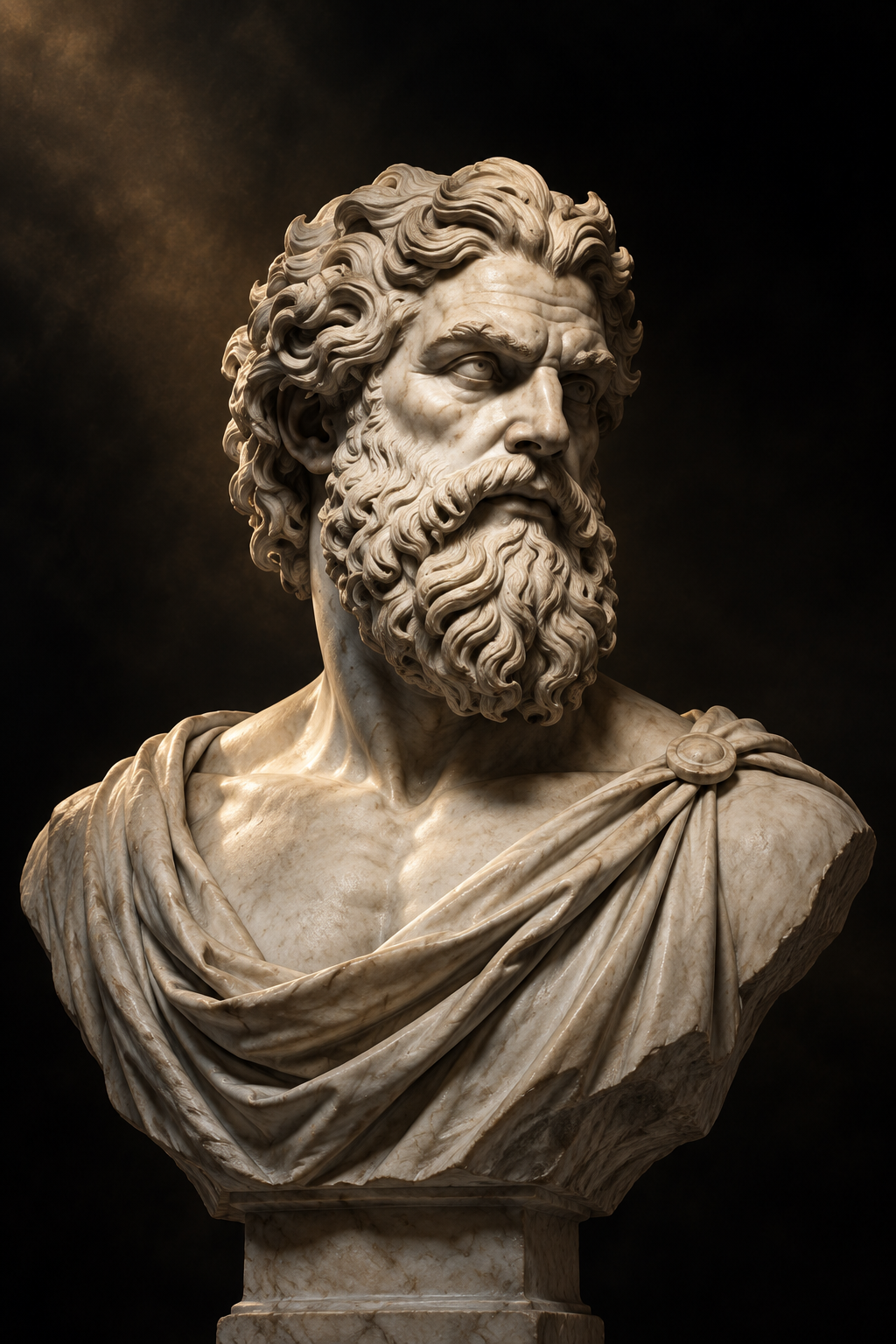
01 · The stories
Myths & defining acts
Castrated Uranus, separating Sky from Earth; swallowed each of his children at birth; was tricked by Rhea into swallowing a swaddled stone instead of the infant Zeus; was defeated in the Titanomachy; in Roman legend then reigned over the Golden Age of Italy.
02 · Sacred lineage
Family & relations
Parents: Caelus (Uranus) and Terra (Gaia). Consort and sister: Ops (Rhea). Offspring: Jupiter, Neptune, Pluto, Juno, Ceres, Vesta.
03 · Places of devotion
Abode & sacred sites
After his defeat, imprisoned in Tartarus, or ruling the Isles of the Blessed (Greek); the Temple of Saturn in the Roman Forum, which housed the state treasury (the Aerarium Saturni) (Roman).
04 · Two traditions
Greek & Roman perspectives
Cronus (Kronos)
A sinister, paranoid Titan king who castrated his father Uranus with a sickle and then swallowed his own newborn children to avoid being overthrown, before Zeus forced him to disgorge them and defeated him.
Saturn
A beloved patron of a golden agricultural era who, legend held, fled to Latium after his defeat and there founded Saturnia and taught farming and law. The Saturnalia (from 17 December) was Rome's most joyful holiday: role-reversal, gift-giving, gambling and feasting, with masters serving slaves - a direct ancestor of later midwinter festivals.
05 · Extensive analysis
A closer reading
Where the Greeks remembered Cronus ambivalently - a tyrant who mutilated his father and devoured his children, yet whose age was also free of toil and war - the Romans kept only the second half of that memory. Their Saturn is a benevolent exiled king of universal abundance, and the Saturnalia, when the normal order was cheerfully turned upside down, was a yearly return to that imagined age of ease and equality. That his temple held the treasury shows how closely Romans tied him to material security.
06 · Sources
From the archive
Text from Gods · greek_roman_gods, row 17. Imported 10 September 2026.