01 · The stories
Myths & defining acts
Drew the sea when the brothers divided the world; lost the contest with Athena for Athens (his salt spring beaten by her olive tree); sent a sea-monster against Troy after King Laomedon cheated him; cursed Odysseus to ten years of wandering for blinding Polyphemus; created the first horse.
02 · Sacred lineage
Family & relations
Parents: Saturn (Cronus) and Ops (Rhea). Siblings: Jupiter, Pluto, Juno, Ceres, Vesta. Consort: Salacia (Amphitrite). Offspring: Triton, Polyphemus, Pegasus, Chrysaor, Theseus, Orion.
03 · Places of devotion
Abode & sacred sites
A golden palace beneath the Aegean / Mount Olympus; the Isthmus of Corinth (Isthmian Games) and Cape Sounion (Greek); the Campus Martius and Circus Flaminius, Rome (Roman).
04 · Two traditions
Greek & Roman perspectives
Poseidon
An archaic, terrifying force, higher than Zeus in some Mycenaean Linear B tablets; the hostile power of coastal water and sudden cataclysm. Sailors made lavish sacrifice to appease him before any voyage.
Neptune
Originally Neptunus, a god of freshwater springs whose festival, the Neptunalia (23 July), fell in the summer drought. Elevated to full sea-sovereign only pragmatically, as Rome was forced to master the Mediterranean and defeat Carthage in the Punic Wars.
05 · Extensive analysis
A closer reading
Poseidon was rooted in Mycenaean religion as a raw, earth-shaking power of the sea and of earthquakes, quick to take offence and nursing long grudges. The historically agrarian Romans first knew Neptunus as a modest god of irrigation and streams; his maritime personality is almost entirely borrowed, and its adoption tracks Rome's sudden and reluctant transformation into a naval empire.
06 · Sources
From the archive
Text from Gods · greek_roman_gods, row 4. Imported 10 September 2026.
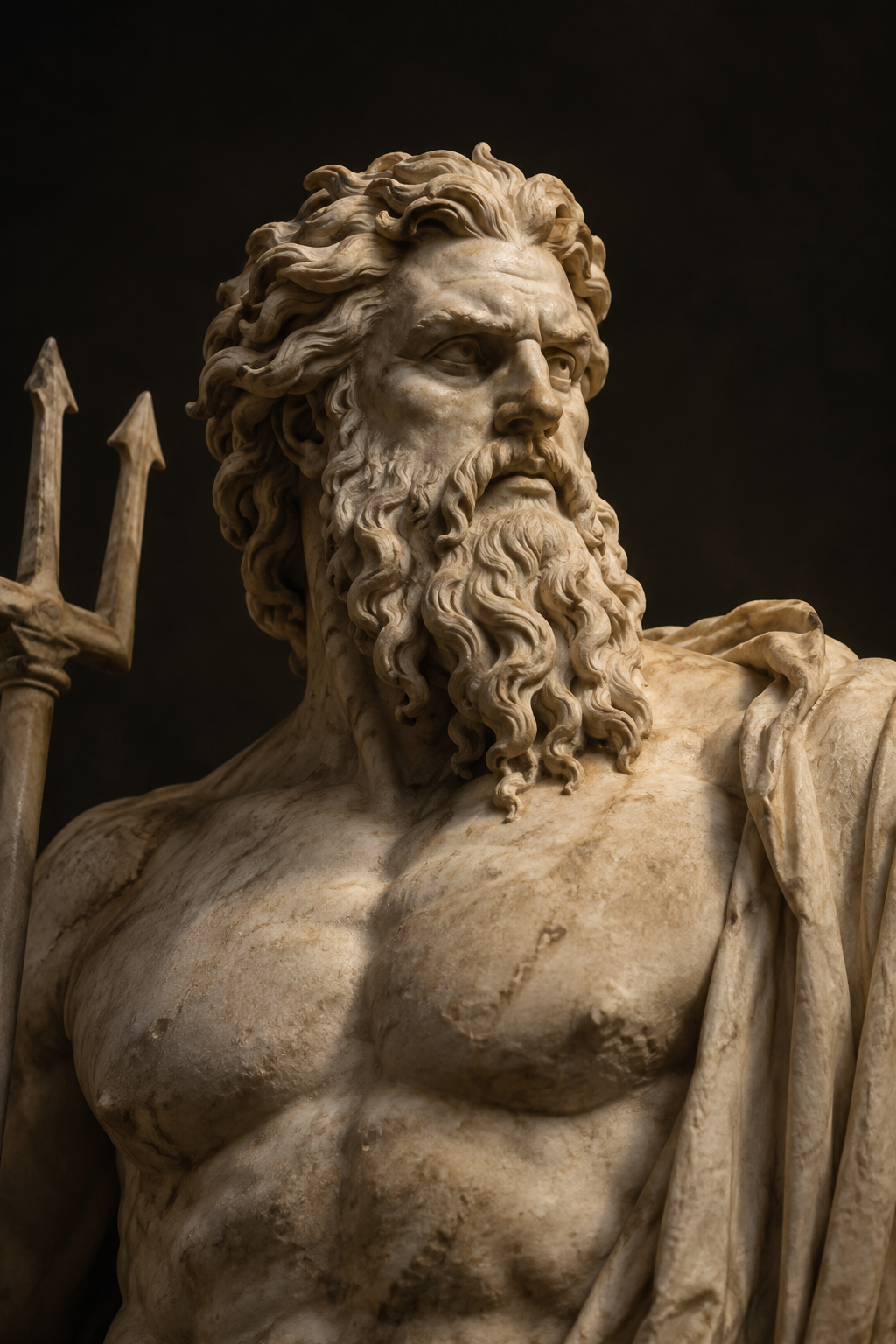
Sculpture image: a generated interpretation inspired by Neptune, Museo Nacional del Prado.