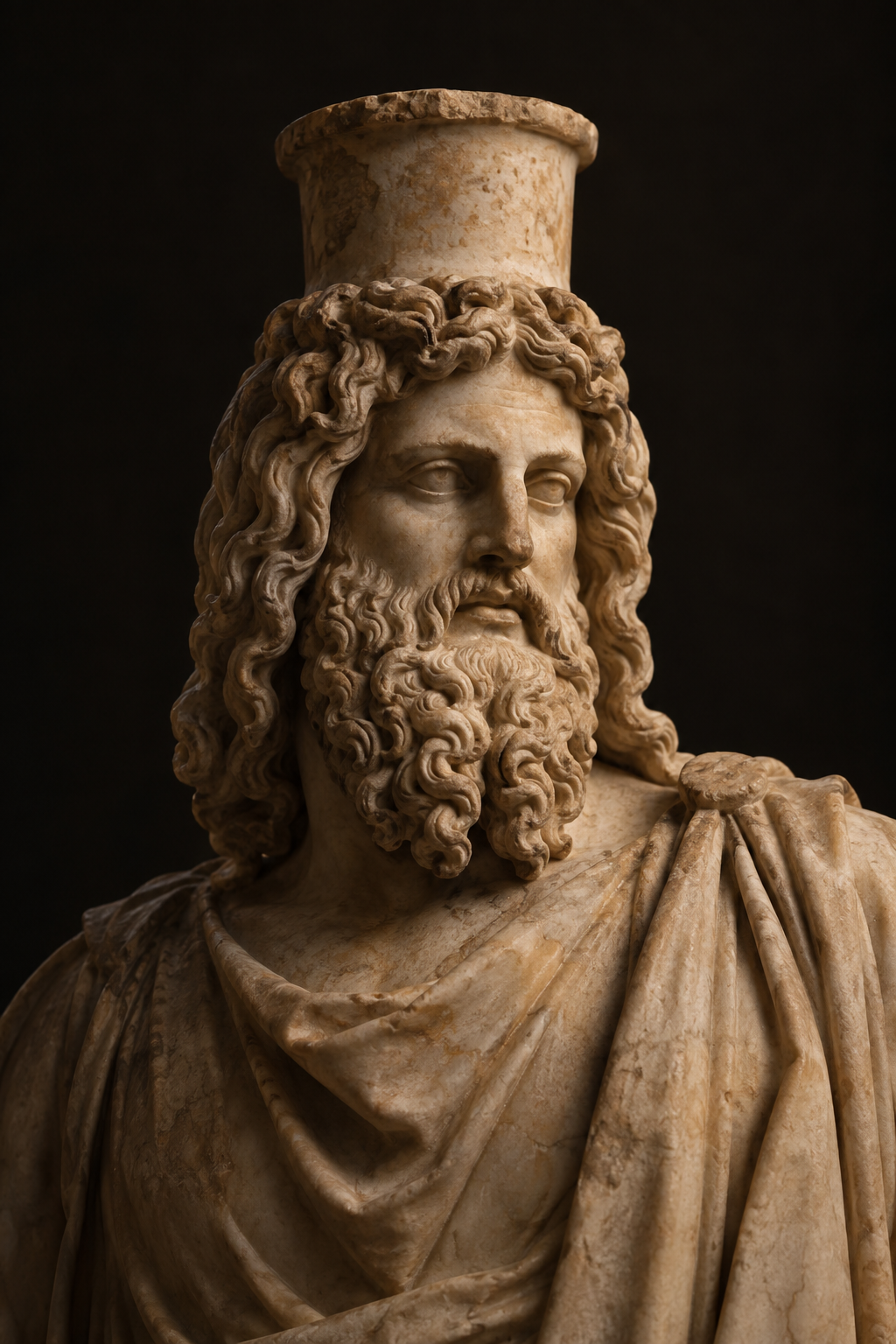
01 · The stories
Myths & defining acts
Abducted Persephone / Proserpina to be his queen, causing Ceres's grief and the origin of the seasons; allowed Orpheus to try to reclaim Eurydice on condition he not look back; trapped Theseus and Pirithous on the chairs of forgetfulness; was tricked by Sisyphus; lent his helmet to Perseus.
02 · Sacred lineage
Family & relations
Parents: Saturn (Cronus) and Ops (Rhea). Siblings: Jupiter, Neptune, Juno, Ceres, Vesta. Consort: Proserpina (Persephone). Generally childless.
03 · Places of devotion
Abode & sacred sites
The subterranean realm, Tartarus and the Fields of Asphodel; entrance caves at Eleusis and at Lake Avernus near Naples; a buried altar in the Campus Martius (the Tarentum), uncovered only for the Secular Games.
04 · Two traditions
Greek & Roman perspectives
Hades
Regarded with dread and quiet awe. Greeks avoided his name, calling him Plouton ('the wealthy one') to appease him. Not evil, but cold, unyielding and just; he never released a soul. Sacrifices were black animals, offered at night with averted faces.
Pluto / Dis Pater (Orcus)
Dis Pater ('rich father') and Pluto, stressing the agricultural and mineral prosperity buried in the soil. Feared in folk belief as Orcus, a shaggy ogre who dragged people down and punished perjurers - a figure that survived into medieval lore and gave fantasy the word 'orc'.
05 · Extensive analysis
A closer reading
Hades is neither devil nor tormentor but the sovereign administrator of finality, keeping the dead dead so cosmic order holds. His realm divides into Tartarus for the wicked, Asphodel for the ordinary, and Elysium for the blessed. Rome fused this authority with the native death-demon Orcus and, through Dis Pater, kept the emphasis agricultural: seed must be buried before it yields wealth, making the lord of the dead also a guarantor of the crop. Formal state cult reached him only at the rare Secular Games, at a hidden altar.
06 · Sources
From the archive
Text from Gods · greek_roman_gods, row 5. Imported 10 September 2026.
Sculpture image: a generated interpretation inspired by Sarapis-Hades (syncretic model), Heraklion Archaeological Museum.