01 · The stories
Myths & defining acts
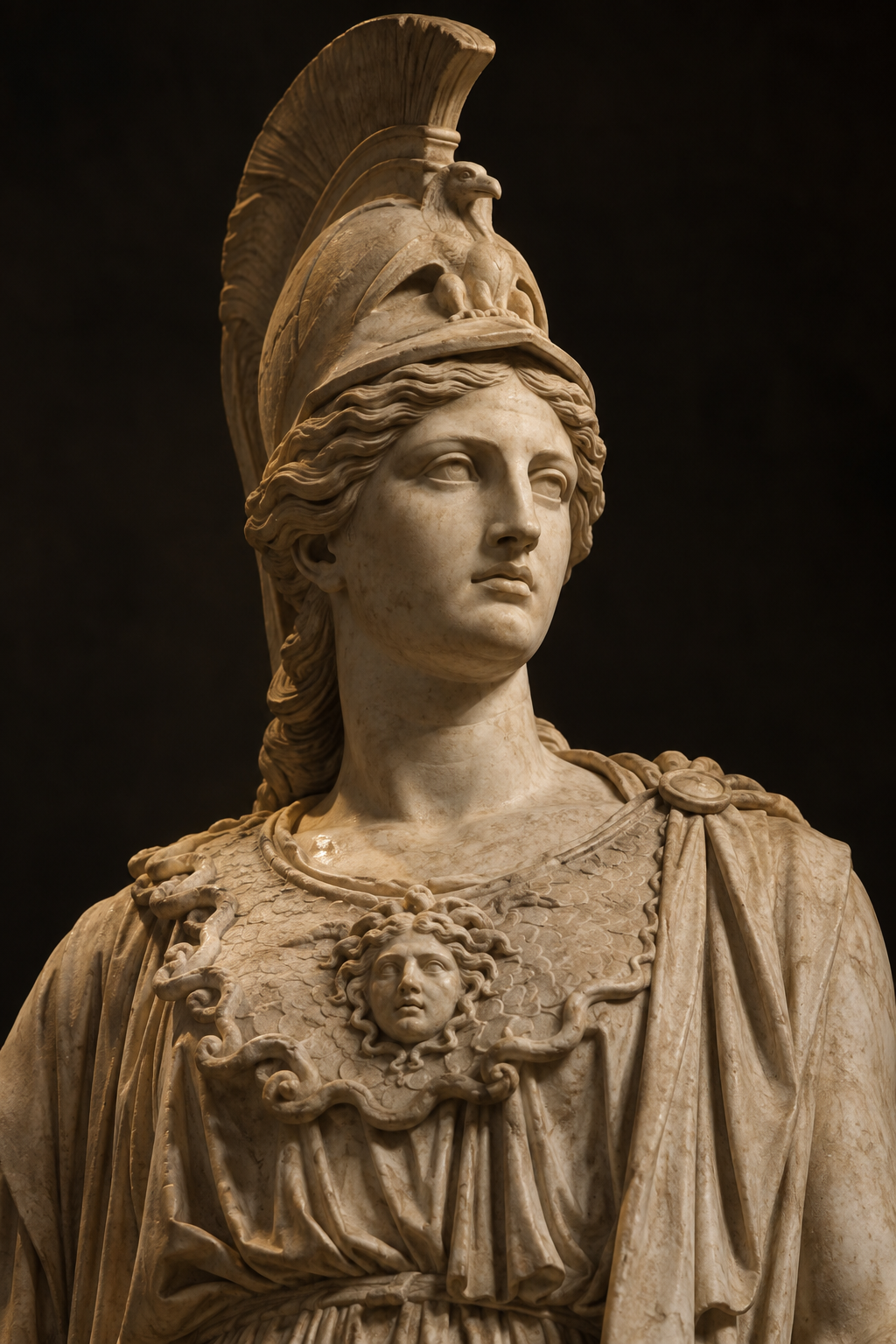
Born full-grown from Zeus's skull; won Athens with the first olive tree, defeating Poseidon's salt spring; helped Perseus kill Medusa and fixed the Gorgon's head on her aegis; turned Arachne into a spider for hubris; sided with the Greeks at Troy; cast the deciding vote to acquit Orestes.
02 · Sacred lineage
Family & relations
Father: Jupiter (Zeus) alone; mother Metis was swallowed while pregnant, and Athena sprang fully armed from his head. A virgin goddess, foster-mother of Erichthonius; no consort or biological children.
03 · Places of devotion
Abode & sacred sites
Mount Olympus; the Acropolis of Athens and the Parthenon, honoured with the Panathenaea and a new woven peplos (Greek); the Capitoline Hill (Capitoline Triad) and the Aventine, Rome (Roman).
04 · Two traditions
Greek & Roman perspectives
Athena (Pallas Athena)
The strategic champion of civilisation, law and intellectual combat over brute force; the very spirit of the polis. Beloved patron of Athens and guide of cunning heroes such as Odysseus, Perseus, Jason and Heracles.
Minerva
Adopted via the Etruscan Menrva, a goddess of arts, crafts and intellect. Rome first stressed her peaceful side - patroness of artisans, doctors, teachers and schoolchildren (the Quinquatrus, 19-23 March) - and only later, under Hellenic influence and generals like Pompey and Domitian, gave her the full armed military mantle.
05 · Extensive analysis
A closer reading
Athena represents the triumph of disciplined intellect and just, defensive war over the bloodlust of Ares; her birth from the head of Zeus makes her divine reason applied to governance. Athens revered her as an invincible citadel-goddess and the heart of its civic life. Early Rome, receiving her through Etruria, emphasised instead her patronage of trades, medicine and education, installing her beside Jupiter and Juno as one of the three great gods of the state before her warlike aspect was fully revived.
06 · Sources
From the archive
Text from Gods · greek_roman_gods, row 6. Imported 10 September 2026.
Sculpture image: a generated interpretation inspired by Pallas de Velletri, Musée du Louvre.