01 · The stories
Myths & defining acts
Relentless pursuit of Hercules (delayed his birth, sent snakes to his cradle, drove him mad, imposed the Twelve Labours); lost the Judgement of Paris and so aided the Greeks against Troy; opposed Aeneas throughout the founding of the Roman line; her sacred geese woke the Capitol during the Gallic siege of 390 BCE.
02 · Sacred lineage
Family & relations
Parents: Saturn (Cronus) and Ops (Rhea). Husband and brother: Jupiter (Zeus). Children: Mars, Vulcan, Juventas (Hebe), Bellona; (Greek) also Eileithyia / Lucina.
03 · Places of devotion
Abode & sacred sites
Mount Olympus; Argos, Mycenae and Samos, where her cult predates Zeus (Greek); the Capitoline Hill and the Temple of Juno Moneta on the Arx, Rome (Roman).
04 · Two traditions
Greek & Roman perspectives
Hera
The legitimate queen of Olympus and guardian of monogamous wedlock, fiercely protective of her dignity and relentless in avenging Zeus's mistresses and their children.
Juno
Juno Regina, member of the Capitoline Triad, and Juno Moneta, protector of funds and adviser to the state. Ritually 'called out' of enemy cities such as Veii by the evocatio. The Matronalia (1 March) honoured her; every Roman woman was thought to have her own guardian 'juno'.
05 · Extensive analysis
A closer reading
Greek literature often traps Hera in reactive jealousy, yet in cult she held immense independent power, older than Zeus in the Peloponnese. Roman Juno evolved far past marital rivalry: as Juno Regina she was invited into Rome from conquered cities; as Juno Moneta her precinct housed the mint, giving European languages the word 'money'. She is at once the divine wife, the ideal Roman matron, and the maternal defender of the whole community and its women.
06 · Sources
From the archive
Text from Gods · greek_roman_gods, row 3. Imported 10 September 2026.
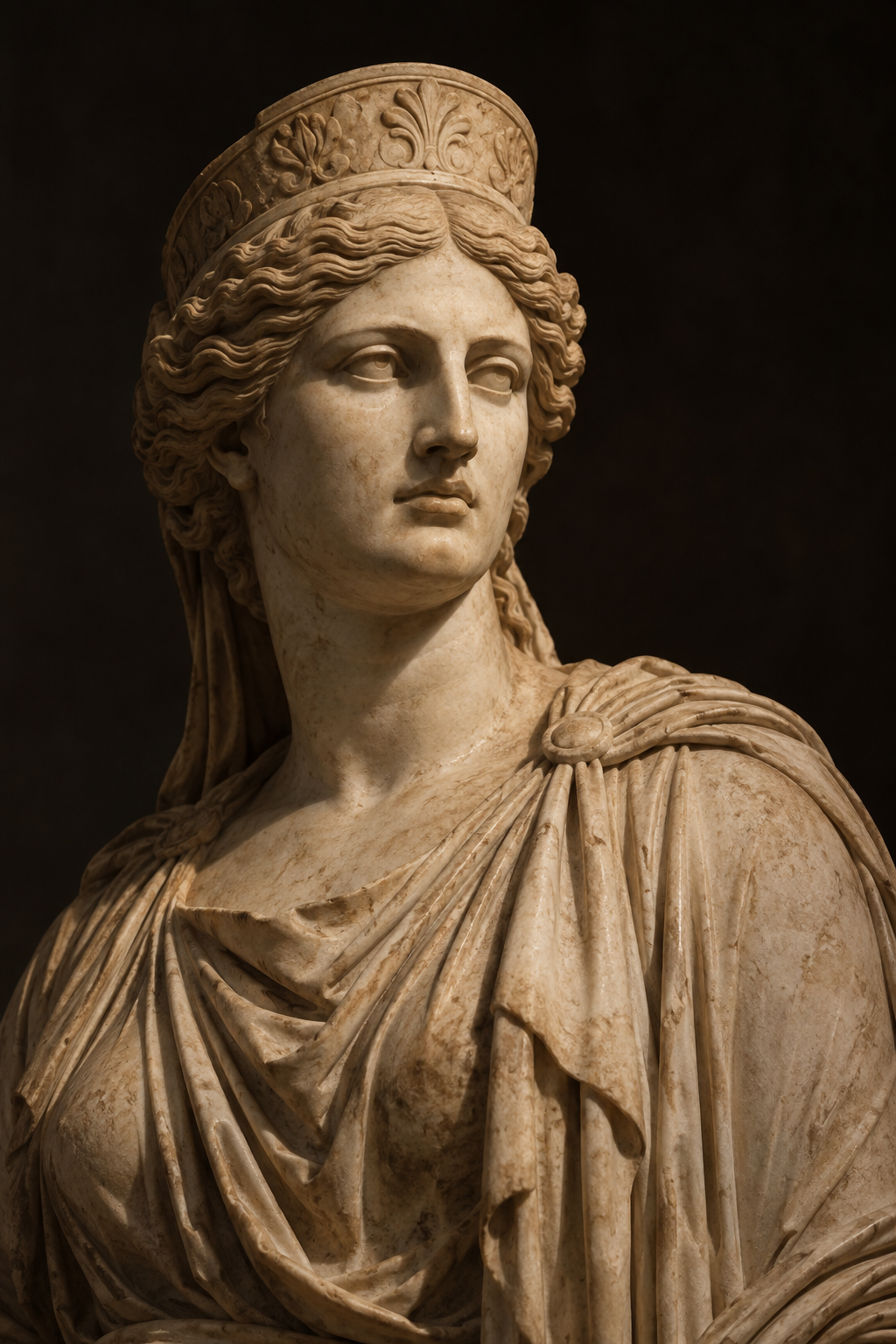
Sculpture image: a generated interpretation inspired by Colossal Juno, Museum of Fine Arts Boston.