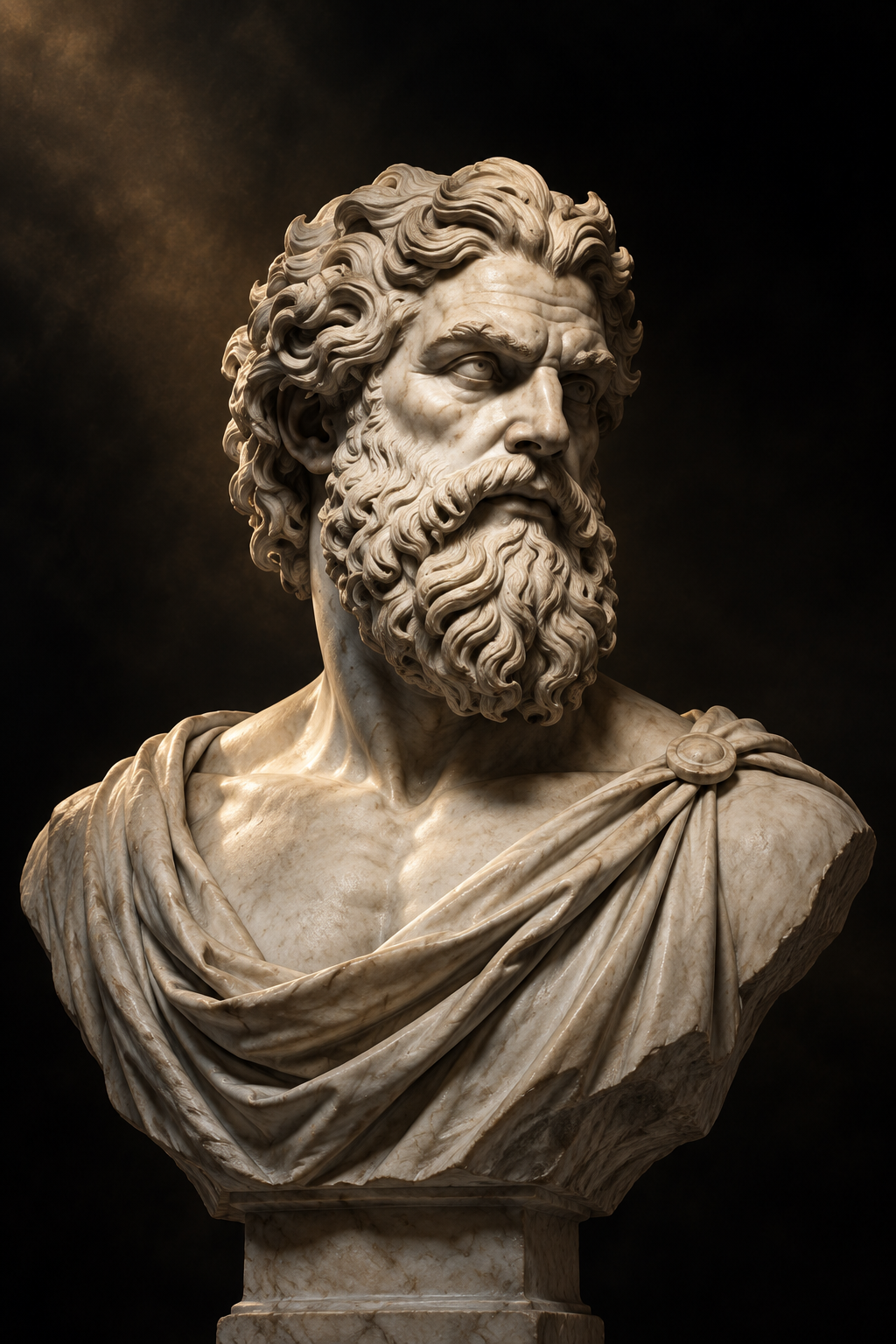
01 · The stories
Myths & defining acts
Fought on the losing Titan side and was sentenced to stand at the western edge of the world holding up the sky forever; briefly tricked Heracles into taking the burden while he fetched the golden apples of the Hesperides (his daughters), then tried to leave him holding it, but Heracles tricked him back; in another tradition Perseus showed him the Gorgon's head and turned him into the stone Atlas Mountains.
02 · Sacred lineage
Family & relations
Parents: the Titan Iapetus and the Oceanid Clymene. Brothers: Prometheus, Epimetheus, Menoetius. Children: the Pleiades, the Hyades, the Hesperides, and Calypso.
03 · Places of devotion
Abode & sacred sites
The far west, near the garden of the Hesperides; the Atlas Mountains of northwest Africa are named for him.
04 · Two traditions
Greek & Roman perspectives
Atlas
No real cult; a mythological and increasingly astronomical figure, treated by some ancient writers as a real early king and astronomer of Mauretania who first taught the celestial sphere.
(Atlas)
Known through Greek myth and Latin poetry; Roman and later art shows him kneeling under the celestial globe (the 'Farnese Atlas' is the oldest surviving depiction of the Greek constellations).
05 · Extensive analysis
A closer reading
Atlas is the Titan whose name became a byword for bearing a crushing weight. After the defeat of the Titans he is singled out for the specific, unending punishment of holding the heavens apart from the earth at the world's western edge. Later antiquity, uneasy with a man literally supporting the sky, reinterpreted him as an early astronomer-king who 'carried the heavens' by understanding them, which is why he is shown with a star-globe. His name attached itself to an ocean and, through the mapmaker Mercator, to the bound book of maps we still call an atlas.
06 · Sources
From the archive
Text from Gods · greek_roman_gods, row 42. Imported 10 September 2026.