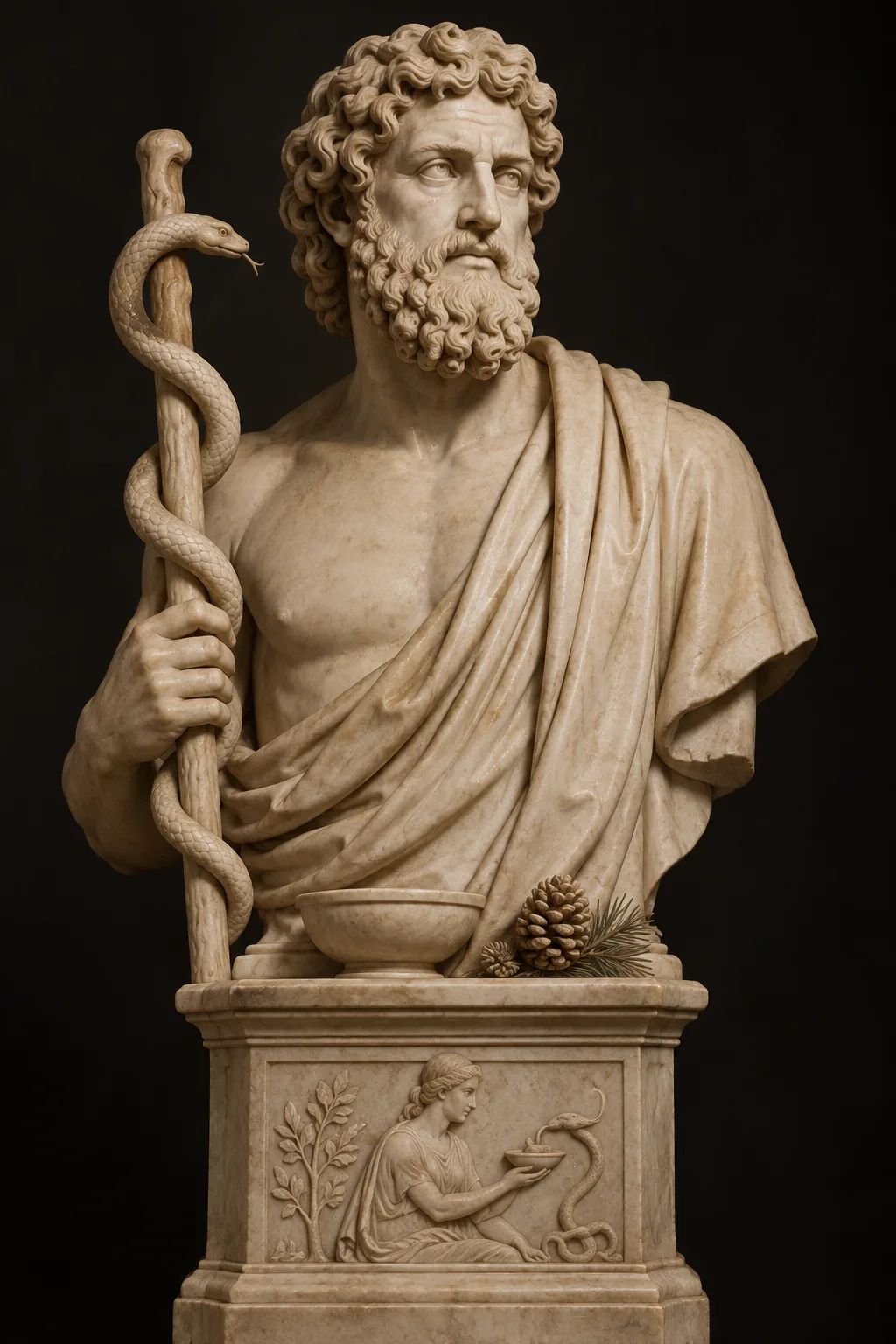
01 · The stories
Myths & defining acts
Is taught healing by Chiron and is killed by Zeus's thunderbolt (Pindar, Pythian 3); his sacred serpent comes to Rome (Ovid, Metamorphoses 15).
02 · Sacred lineage
Family & relations
Father: Apollo; mother: Coronis (Pindar, Pythian 3). In the Iliad, Machaon is the son of the great physician Asclepius (4.193–194). Modern reference works list Epione as his consort and Panacea, Hygieia and Machaon among his children.
Greek literary genealogies and Roman cult identities are not interchangeable. Explore the family tree and its traditions.
03 · Places of devotion
Abode & sacred sites
Epidaurus, where Pausanias describes the gold-and-ivory image of Asclepius by Thrasymedes (2.27.2); in Rome, according to Ovid, the sacred serpent came up the Tiber to the island (Metamorphoses 15).
04 · Two traditions
Greek & Roman perspectives
The Greek perspective
In the Iliad, Asclepius is the great physician whose son Machaon is summoned to treat Menelaus (4.193–194). In Pindar, Asclepius is taught by Chiron, heals many, but is struck down by Zeus's thunderbolt (Pythian 3). Pausanias saw the gold-and-ivory image of Asclepius at Epidaurus (2.27.2).
The Roman perspective
In Ovid's Metamorphoses, a sacred serpent of Aesculapius travels up the Tiber and the god's cult is established at Rome (book 15).
05 · Extensive analysis
A closer reading
Asclepius is a physician in Homer and a healer-god in Pindar, who is struck down by Zeus. At Epidaurus he had a gold-and-ivory image; in Rome, Ovid tells of the arrival of his serpent.
06 · Primary sources
What the sources say
These are the main ancient passages behind this entry, with what each one actually says.
- Homer, Iliad book 4, lines 193–194
Agamemnon tells Talthybios to fetch Machaon, son of the great physician Asclepius, to see the wounded Menelaus.
Read the passage - Pausanias, Description of Greece book 2, chapter 27, section 2
At Epidaurus the image of Asclepius is half as big as the Olympian Zeus at Athens and is made of ivory and gold, by Thrasymedes of Paros.
Read the passage - Ovid, Metamorphoses book 15, lines 622–744 (Latin text)
A serpent of Aesculapius is brought by ship to Rome and arrives at the mouth of the Tiber to the cheers of the people.
Read the passage - Wikipedia, Asclepius, a modern summary infobox
Lists Epione among his consorts, Panacea, Hygieia, Machaon and others as his children, and the serpent-entwined staff as his symbol.
Read the passage
07 · Story & deeper insight
Asclepius and the boundary of healing
Pindar tells of Asclepius, the healer taught by Chiron, who uses his skill to bring a dead person back to life. Zeus strikes him with a thunderbolt. In this version payment contributes to the transgression, making the story concerned with both the reach of knowledge and the temptation to misuse it. Other accounts frame the divine objection differently.
The myth places healing at a boundary: restoring health is beneficial, but abolishing death would alter the order governing all mortals.
Roman Aesculapius was associated with a famous importation from Epidaurus during an epidemic, with a serpent central to the foundation tradition. Reading the god through both literature and cult shows hope, expertise and mortality meeting in a single divine figure.