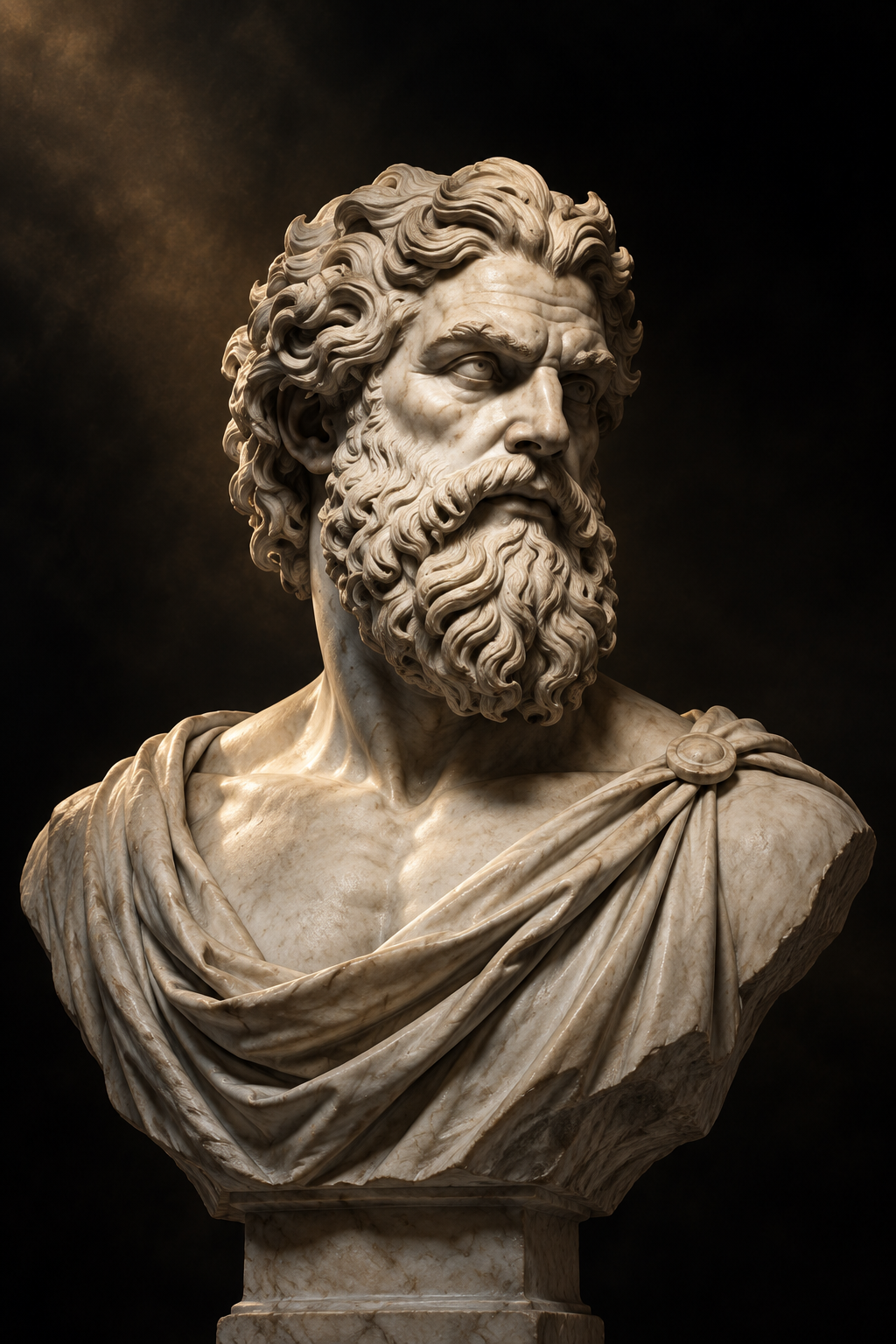
01 · The stories
Myths & defining acts
Let his rash son Phaethon steer the sun chariot for a day; Phaethon lost control, scorched the earth (creating deserts and, in myth, the Ethiopians' dark skin), and was struck down by Zeus's thunderbolt to save the world; his sacred cattle on Thrinacia were eaten by Odysseus's starving crew, who then all drowned; he exposed the affair of Ares and Aphrodite.
02 · Sacred lineage
Family & relations
Parents: the Titans Hyperion and Theia. Siblings: Eos (Dawn) and Selene (Moon). Consorts: Perse, Clymene. Children: Phaethon, Circe, Pasiphae, the Heliades.
03 · Places of devotion
Abode & sacred sites
A golden palace in the far east; the island of Rhodes, where the Colossus (one of the Seven Wonders) represented him (Greek); a shrine on the Quirinal (Sol Indiges), later a great temple to Sol Invictus, Rome (Roman).
04 · Two traditions
Greek & Roman perspectives
Helios
The daily driver of the solar chariot from east to west; invoked as an impartial witness to oaths because nothing on earth escapes his gaze. In classical Athens his role was largely absorbed by Apollo, though he kept a strong cult on Rhodes.
Sol (Sol Indiges / Sol Invictus)
Originally Sol Indiges, an early agrarian sun-god with a festival on 9 August. In 274 CE the Emperor Aurelian elevated Sol Invictus ('the Unconquered Sun') into a near-monotheistic imperial state cult, with a feast on 25 December, whose imagery influenced later Roman Christian art.
05 · Extensive analysis
A closer reading
Helios is the literal sun given a face and a chariot, distinct in classical thought from Apollo, the god of intellectual and spiritual light, though the two merged in later syncretism. Because he looks down on everything he is the natural witness of oaths and secret deeds. In Rome the sun rose to enormous official importance in the third century as Sol Invictus, an imperial god whose midwinter festival and radiate imagery fed directly into the visual language of the later empire.
06 · Sources
From the archive
Text from Gods · greek_roman_gods, row 30. Imported 10 September 2026.