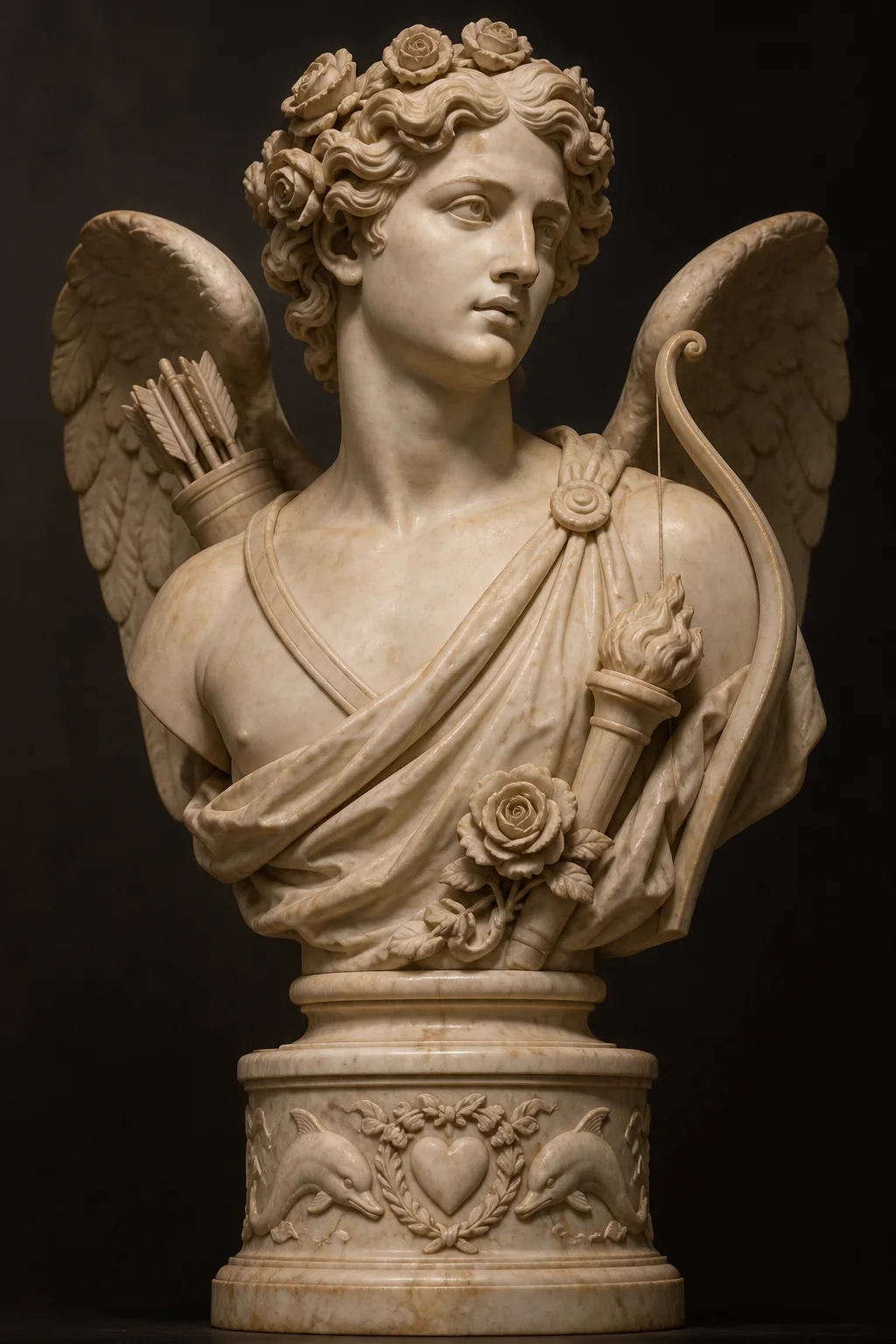
01 · The stories
Myths & defining acts
Strikes Pluto with love at Venus's request (Ovid, Metamorphoses 5); in Ovid's Apollo and Daphne story the gold and lead arrows cause and refuse love (Metamorphoses 1); and in Apuleius's Golden Ass, is the unseen husband of Psyche: she brings a lamp and sees him, a drop of burning oil falls on his shoulder, and he flees (book 5).
02 · Sacred lineage
Family & relations
In Hesiod, Eros is among the first cosmic powers, without a stated genealogy. Later traditions make him a child of Aphrodite, with varying fathers. The story of Cupid and Psyche belongs to a later literary tradition; their daughter is Pleasure (Voluptas).
Greek literary genealogies and Roman cult identities are not interchangeable. Explore the family tree and its traditions.
03 · Places of devotion
Abode & sacred sites
At Thespiae, Pausanias says, the Thespians honoured Love most of all the gods, with a very ancient image of him, an unwrought stone (9.27.1).
04 · Two traditions
Greek & Roman perspectives
The Greek perspective
In Hesiod, Eros is a primal power and a companion of Aphrodite (Theogony 116–122, 201–202). Pausanias reports that the Thespians had honoured him from the beginning above all other gods (9.27.1).
The Roman perspective
In Ovid, Venus takes her winged Cupid in her arms, calls him her son, her hand and her might, and tells him to strike Pluto's heart with love (Metamorphoses 5.362–384). Apuleius's Golden Ass tells the story of Cupid and Psyche (books 4–6).
Compare the two traditions side by side: Eros vs Cupid, with passages cited.
05 · Extensive analysis
A closer reading
Hesiod's Eros is one of the first powers; Ovid's Cupid is the winged son of Venus; and Apuleius makes him the husband of Psyche in the longest surviving ancient telling. See the Eros vs Cupid comparison.
06 · Primary sources
What the sources say
These are the main ancient passages behind this entry, with what each one actually says.
- Pausanias, Description of Greece book 9, chapter 27, section 1
The Thespians have from the beginning honoured Love most of the gods, and have a very ancient image of him, an unwrought stone.
Read the passage - Apuleius, The Golden Ass (Adlington translation) book 5
Psyche brings the lamp and sees Cupid asleep; a drop of burning oil falls from the lamp on the right shoulder of the god, and he flees.
Read the passage
07 · Story & deeper insight
Cupid and Psyche: love under impossible conditions
Psyche's beauty provokes Venus, and her marriage to an unseen lover brings comfort together with a strict prohibition: she must not look at him. Persuaded that he may be a monster, she lights a lamp and discovers Cupid. A drop of hot oil wakes him, and the relationship collapses. Psyche then undertakes seemingly impossible tasks imposed by Venus before eventual reconciliation and divine marriage.
The tale explores trust under conditions of unequal knowledge. Psyche's curiosity is understandable, but her attempt to remove uncertainty damages the fragile arrangement. The later tasks place her in dependence on unexpected helpers, so perseverance is not a purely individual achievement.
This extended narrative survives in a Roman novel, not as a standard episode in every Greek cult of Eros. Apuleius embeds it in a larger work concerned with misadventure and transformation. Its combination of romance, suffering and eventual elevation made it exceptionally influential, while leaving readers to debate whether the ending resolves the inequalities that generated the story.