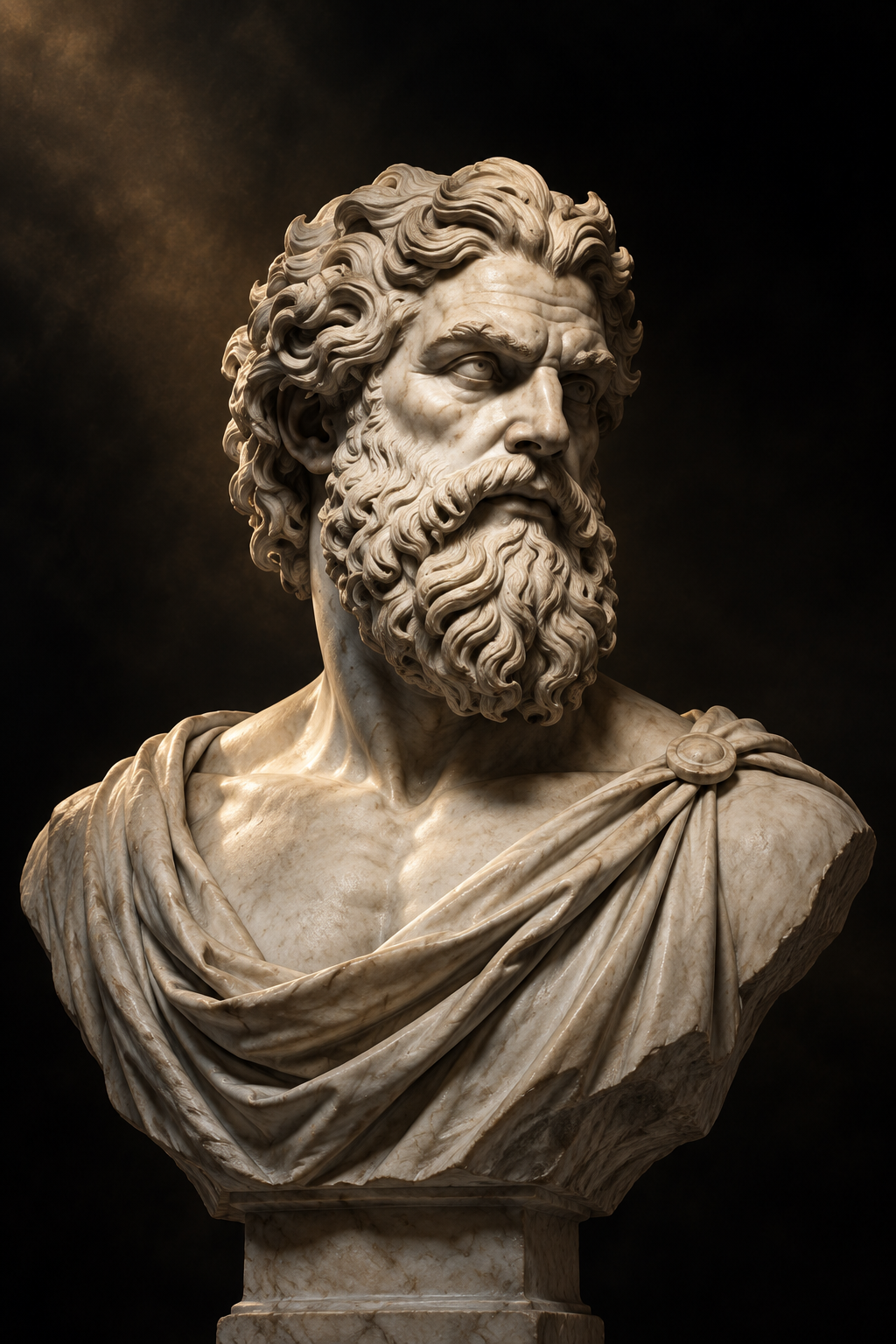
01 · The stories
Myths & defining acts
Slew the serpent Python at Delphi and claimed the oracle; flayed the satyr Marsyas after a music contest; his love Daphne became a laurel to escape him; accidentally killed Hyacinthus; struck the Greek camp with plague in the Iliad's opening; his son Phaethon lost the sun chariot.
02 · Sacred lineage
Family & relations
Parents: Jupiter (Zeus) and Latona (Leto). Twin sister: Diana (Artemis). Unmarried. Offspring: Asclepius (medicine), Orpheus, Aristaeus, Troilus.
03 · Places of devotion
Abode & sacred sites
Mount Olympus; Delos (his birthplace), Delphi (his oracle, spoken through the Pythia) and Mount Parnassus with the Muses (Greek); the Temple of Apollo Palatinus built by Augustus beside his own house, Rome (Roman).
04 · Two traditions
Greek & Roman perspectives
Apollo (Phoebus)
The Hellenic ideal of harmony, youth and intellectual refinement (kalokagathia); feared for his plague-arrows and sought across the Mediterranean for the infallible Delphic oracle, which guided colonies and treaties. Leader of the Muses.
Apollo (Phoebus Apollo)
Adopted directly under his Greek name, with no indigenous equivalent (a temple was vowed in 433 BCE after a plague). Revered as an averter of disease, then elevated by Augustus into a personal patron and emblem of the restored Golden Age after Actium; central to the Secular Games.
05 · Extensive analysis
A closer reading
Apollo is unique among the great gods in keeping the same name in both languages. He governs both the bright ordered world of art, prophecy and self-knowledge - the Delphic maxims 'know thyself' and 'nothing in excess' are his - and the sudden arrows of plague, and he is often set against the ecstatic Dionysus as reason against frenzy. Only later did he fully become a sun-god. Augustus turned him into a political icon of peace and civil restoration, placing his marble temple next to the imperial residence on the Palatine.
06 · Sources
From the archive
Text from Gods · greek_roman_gods, row 9. Imported 10 September 2026.