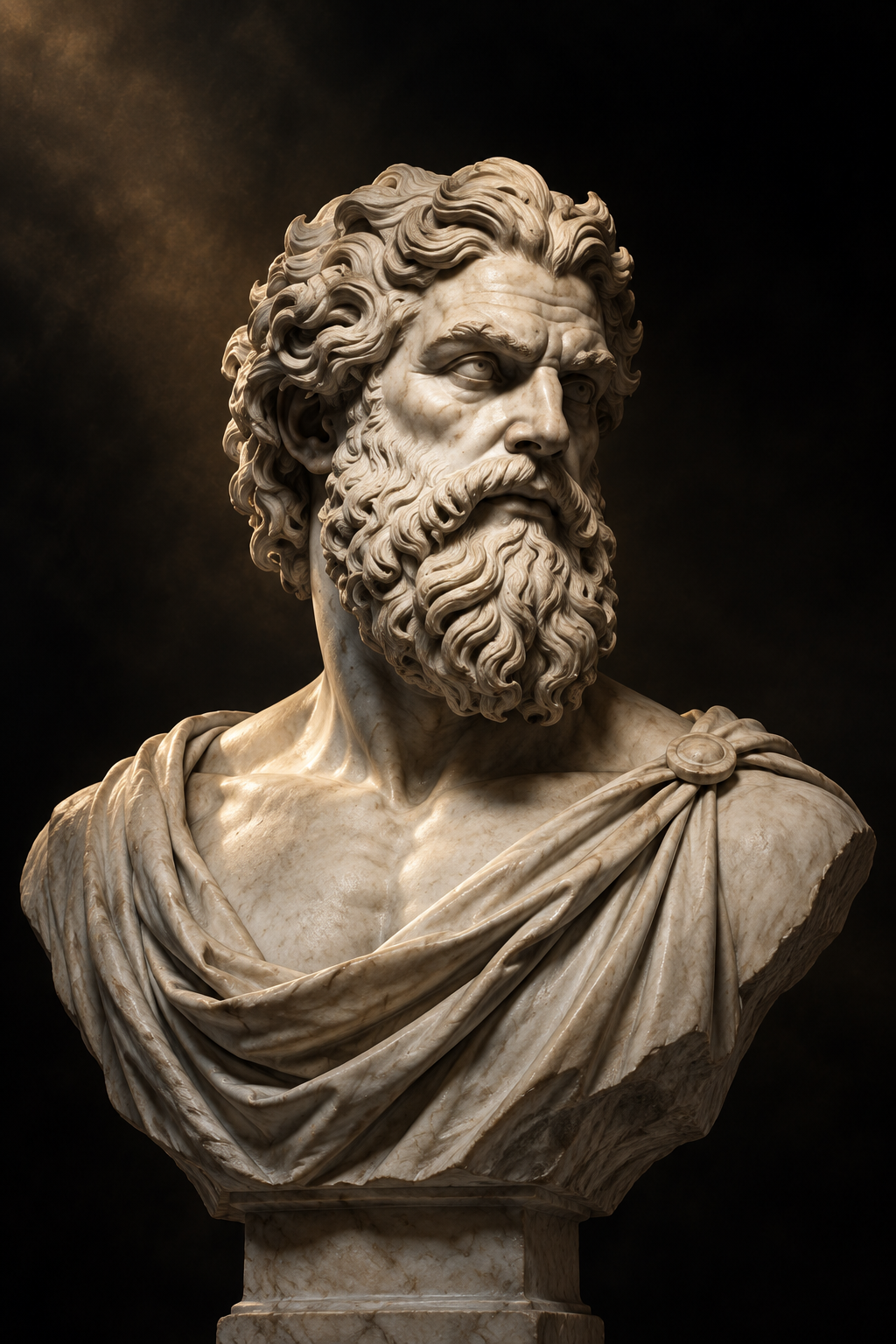
01 · The stories
Myths & defining acts
Strangled two snakes in his cradle; driven mad by Hera, killed his own children, and in penance performed the Twelve Labours (Nemean lion, Hydra, Erymanthian boar, Ceryneian hind, Stymphalian birds, Augean stables, Cretan bull, mares of Diomedes, belt of Hippolyta, cattle of Geryon, apples of the Hesperides, Cerberus); held up the sky for Atlas; freed Prometheus; died in a poisoned robe, was burned on a pyre, and ascended to Olympus.
02 · Sacred lineage
Family & relations
Father: Jupiter (Zeus). Mother: the mortal Alcmene. Mortal wives: Megara, Deianira. Divine wife after apotheosis: Juventas (Hebe). Many children (the Heraclidae).
03 · Places of devotion
Abode & sacred sites
Lived on earth as a man, then was deified and taken to Olympus; his major Roman shrine was the Ara Maxima in the Forum Boarium, the cattle market.
04 · Two traditions
Greek & Roman perspectives
Heracles (Herakles)
Worshipped both as a hero, with chthonic rites at tombs, and as a god, with Olympian rites; patron of athletes and of young men entering adulthood; the mythical founder of the Olympic Games.
Hercules
One of the earliest foreign cults Rome adopted. At the Ara Maxima a tenth of profits and spoils was offered; he was patron of victorious generals, merchants and of oaths sworn by men ('mehercule'), and as Hercules Musarum was linked to the Muses.
05 · Extensive analysis
A closer reading
Heracles is the supreme hero of Greek myth and the only major figure to cross fully from mortal to god. His life is a chain of superhuman feats and terrible sufferings, most driven by Hera's hatred, and he stands for brute strength harnessed to civilisation - clearing the world of monsters and tyrants - and for endurance under undeserved punishment. His bodily ascent to Olympus made him a lasting symbol of virtue rewarded and of a human winning immortality by his deeds. Rome adopted his cult very early and recast him as a god of victory, trade and good faith.
06 · Sources
From the archive
Text from Gods · greek_roman_gods, row 33. Imported 10 September 2026.